






Weirs Beach Arrow Sign
How old is the Weirs Beach Arrow sign?
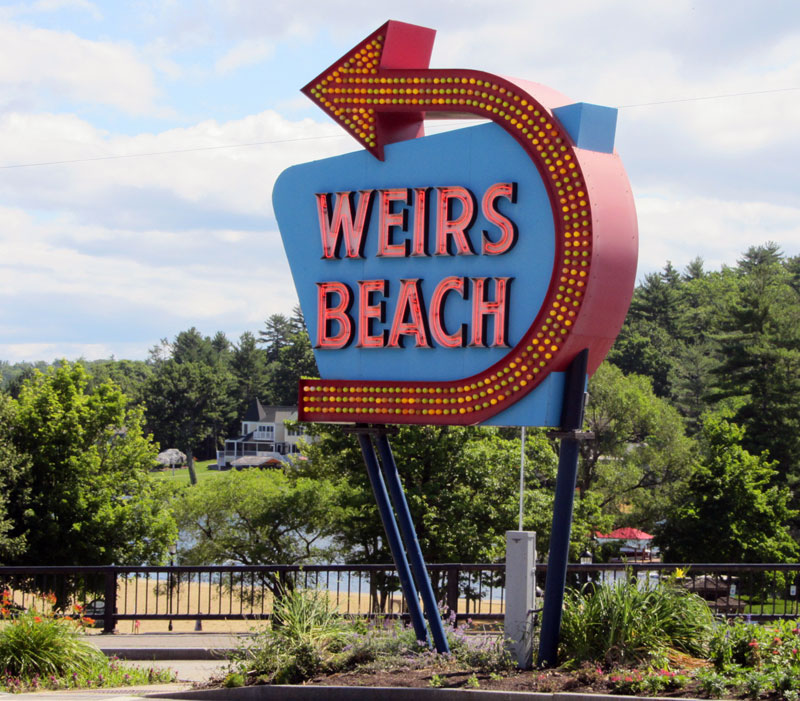
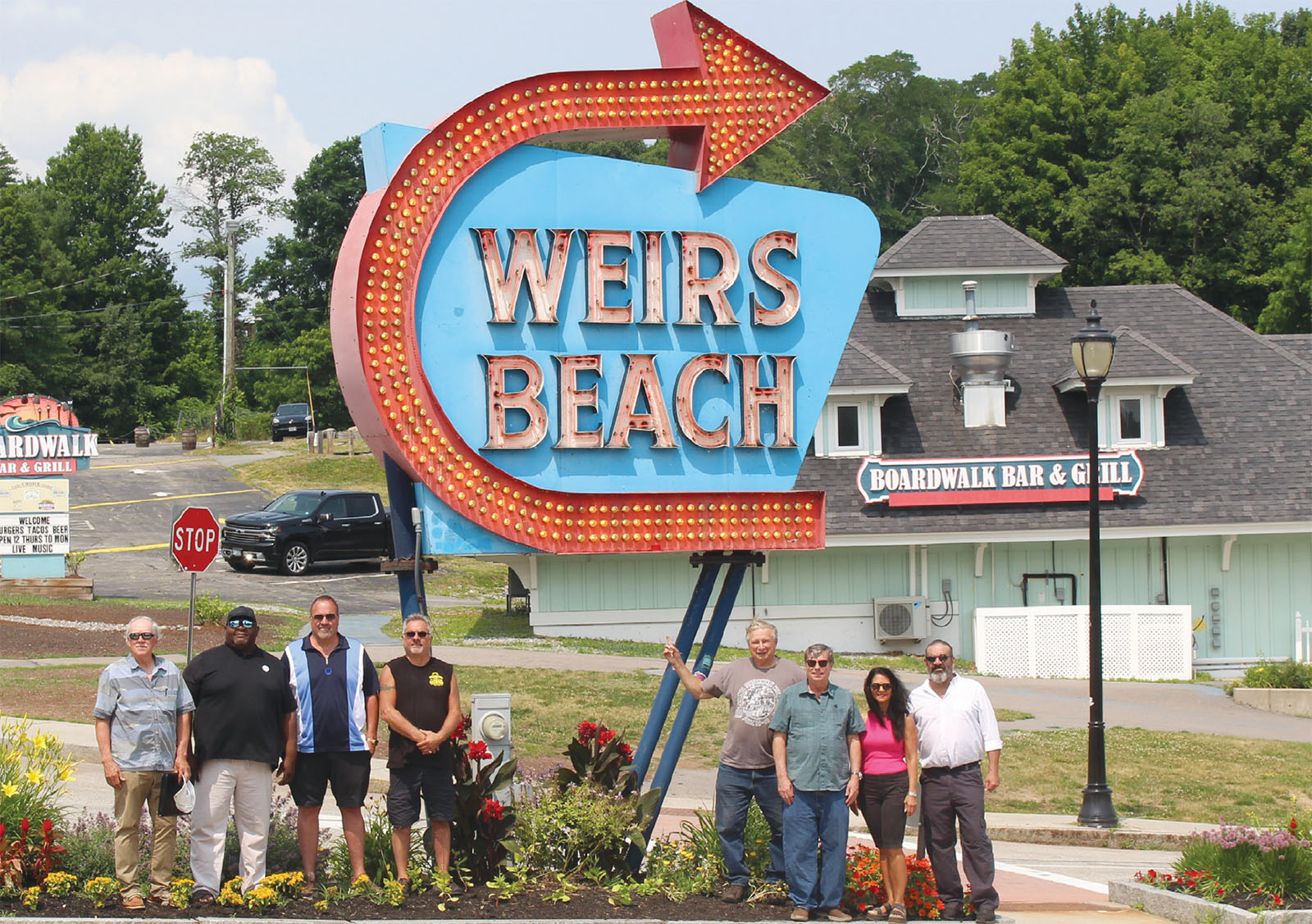
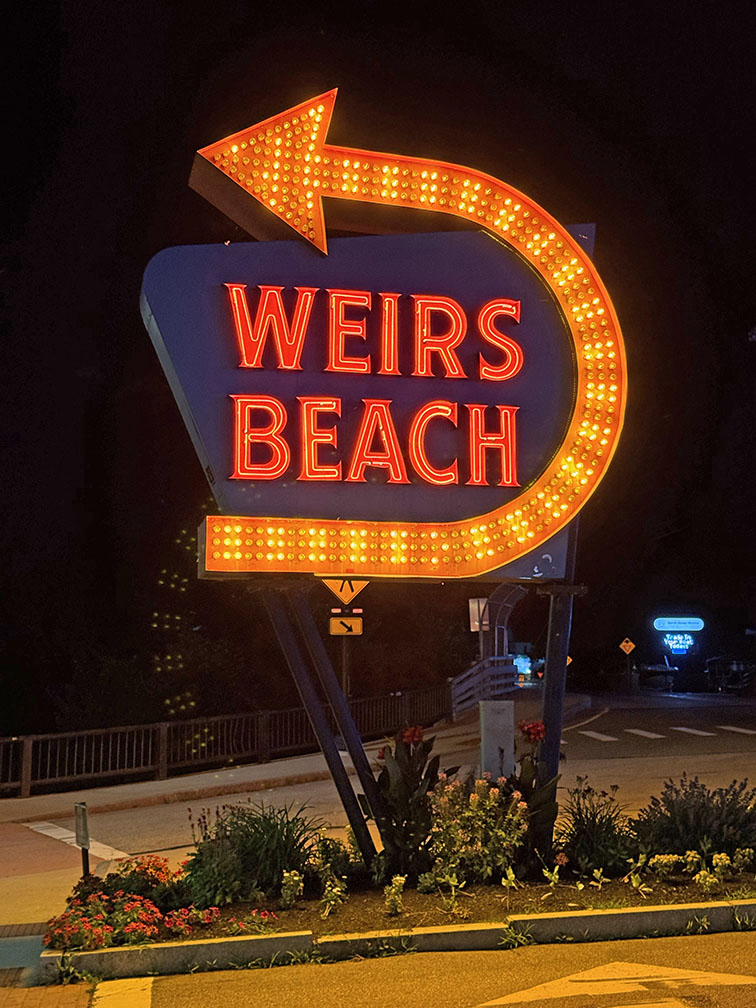
The world-famous neon Weirs Beach Arrow sign was erected on Saturday, July 21, 1956. It was designed and built by Arthur “Red” S. Dale, a neon sign expert who worked for Tyler Advertising of Laconia, at a cost of $2,200 (about $27,000 in 2026 money). The sign celebrated its 50th birthday on Friday, May 26, 2006, after an extensive renovation spearheaded by the Weirs Action Committee. The sign features 696 chaser bulbs, 200 feet of neon tubing, and lights up in a distinctive pattern beckoning visitors to Weirs Beach. Weighing in at 4400 lbs, the sign was restored in mid-January 2002 to a relocated traffic island, 8 feet closer to Lakeside Ave and off the state right-of-way on Route 3. The relocation resulted in an improved traffic flow, with two lanes of one-way traffic on either side of the sign (previously, there was one-lane, two-way traffic on either side of the sign.) The relocation plan had called for a left-hand turning lane off of Route 3 southbound, but there wasn’t enough room. One interesting feature of the sign is that it is two-sided. For visitors coming from Laconia and other points South of Weirs Beach, and who are travelling North on Route 3, it will point to the right; while for visitors coming from Meredith and other points North of Weirs Beach, and who are travelling South, it will point to the left.
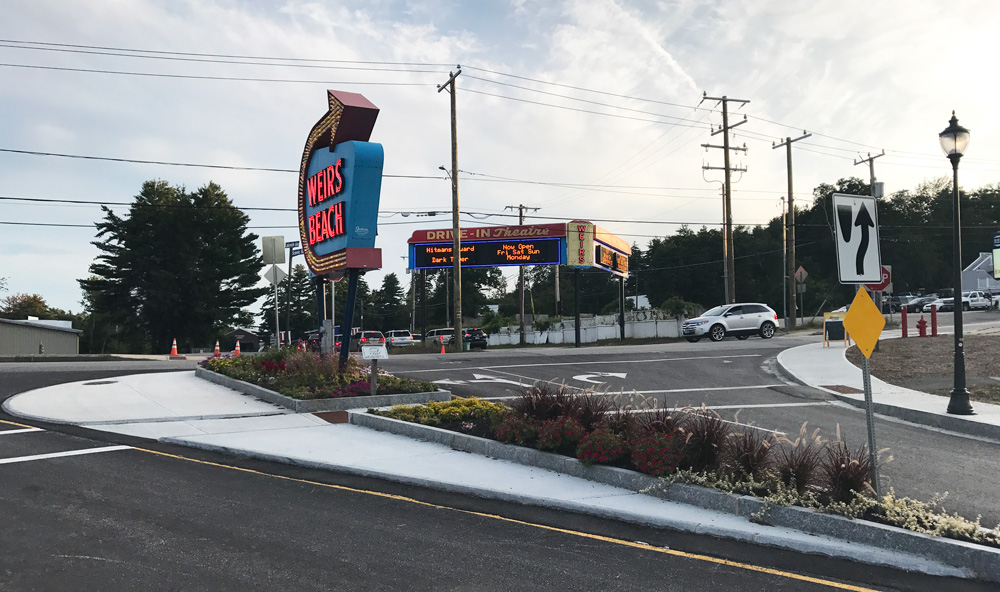
In 2017, a Lakeside Avenue improvement project resulted in a larger, two island base for the sign, with a new crosswalk crossing between the upper and lower islands. While the new design maintained two-lane, one way traffic on the northern side of the sign, the new upper island purposely restricts the southern side to one lane entering Lakeside Avenue. (The photo below shows the temporary, painted line crosswalk in August 2017. A few months later, a permanent, faux-brick, colored concrete crosswalk was installed.) In May, 2018, an irrigation system was completed to the two islands.
The orginal chaser bulbs were made of glass, had a yellow-painted coating on the inside of the lightbulb, and used 11 watts of electricity. In 2018, the bulbs were switched to a transparent yellow plastic, but the bulbs were still incandescent, and the inside element still used 11 watts. In 2024, the bulbs began to be gradually switched over to 2-watt LED versions, still made of transparent yellow plastic. In early May, 2026, the transition to all-LED bulbs was completed.
Another change was internal. The original chaser was a mechanism consisting of a small motor with a rotating spindle that would trigger four different bulb groupings as the spindle brushed past the contacts. Over time, the contacts would wear out, and after several years the mechanism would have to be rebuilt or replaced. In 2015, the mechanical chaser was replaced with a solid-state relay that sequences the four lightbulb circuits electronically, in what is known as a “3-on, 1-off” pattern. The new chaser relay has no moving parts, and it has lasted until the present day.
The fragile glass neon tubes spelling out “Weirs Beach” require replacement from time to time. Some letters ( the “R”, the “B”, and the “A”) contain two tubes – an inner tube and an outer tube. Each of the four words (two per side) is on a separate circuit. When a neon letter is out, it will cause the whole neon word to go out. When this happens, the sign company will come and insert a temporary jumper over the broken tube section to re-light the rest of the word. Then, the company will construct a replacement tube. Only a few sign companies are left that have the expertise for this kind of custom glass work. Currently, the sign is maintained by Ne-Op-Co of Concord, NH.
HISTORY OF THE WEIRS BEACH ARROW SIGN
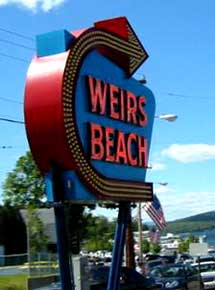
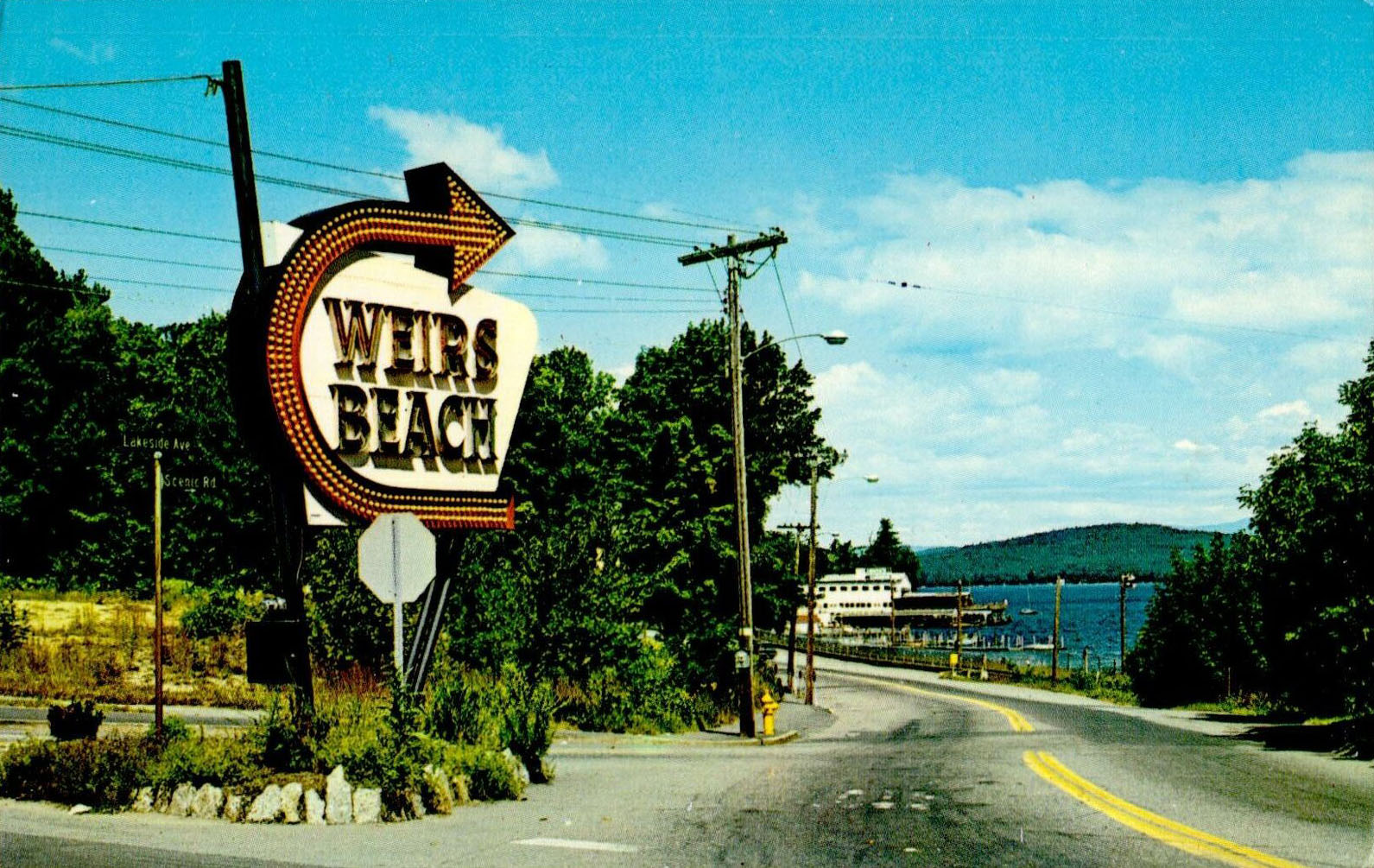
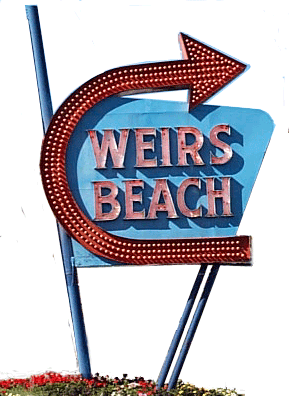
The original colors of the Weirs Beach Arrow sign, seen below in the circa 1957 postcard and copy-cat decal, were yellow and black. (The postcard also shows the original traffic island, and behind it, the Endicott House Restaurant.) The sign was yellow, the supporting poles were black, and the arrrow was black. Today, the sign is light blue, the supporting poles are dark blue, and the arrow is red. Also note the mast pole atop the sign. Before restoration, power to the sign was fed from overhead utility lines and down the mast pole. After restoration, power was fed from an underground line and up the main bottom pole. Unfortunately, during the restoration, a key element of the original design, the mast pole, was removed. With the mast pole, the original sign was tall and well-proportioned. Without the mast pole, the sign doesn’t look quite as elegant.

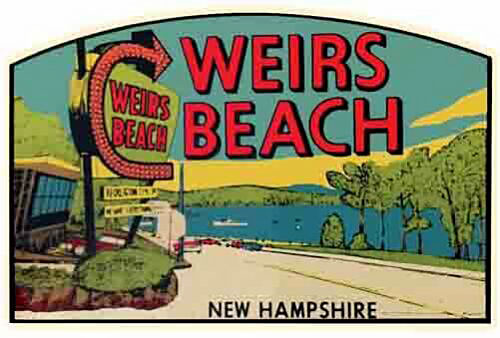
Compare the old sign, with mast pole, on left; to the new sign, with no mast pole, on right
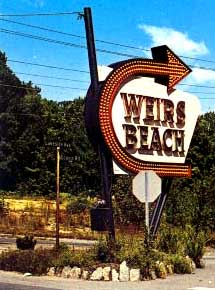
A 1970s photo of the Weirs Beach Arrow sign. In the photo, the sign looks like it is turned off, but it may not be. In full sunshine, sometimes the lit-up bulbs cannot be distinguished photographically. For decades, the practice was to leave the sign turned on all the time during the summer season, then turn it off for the colder half of the year. (Initially, the sign was turned on May 15-October 15. In later years, from May 1-Nov 1.) Since the 2024 summer season, the sign has been left on on a year-round basis.
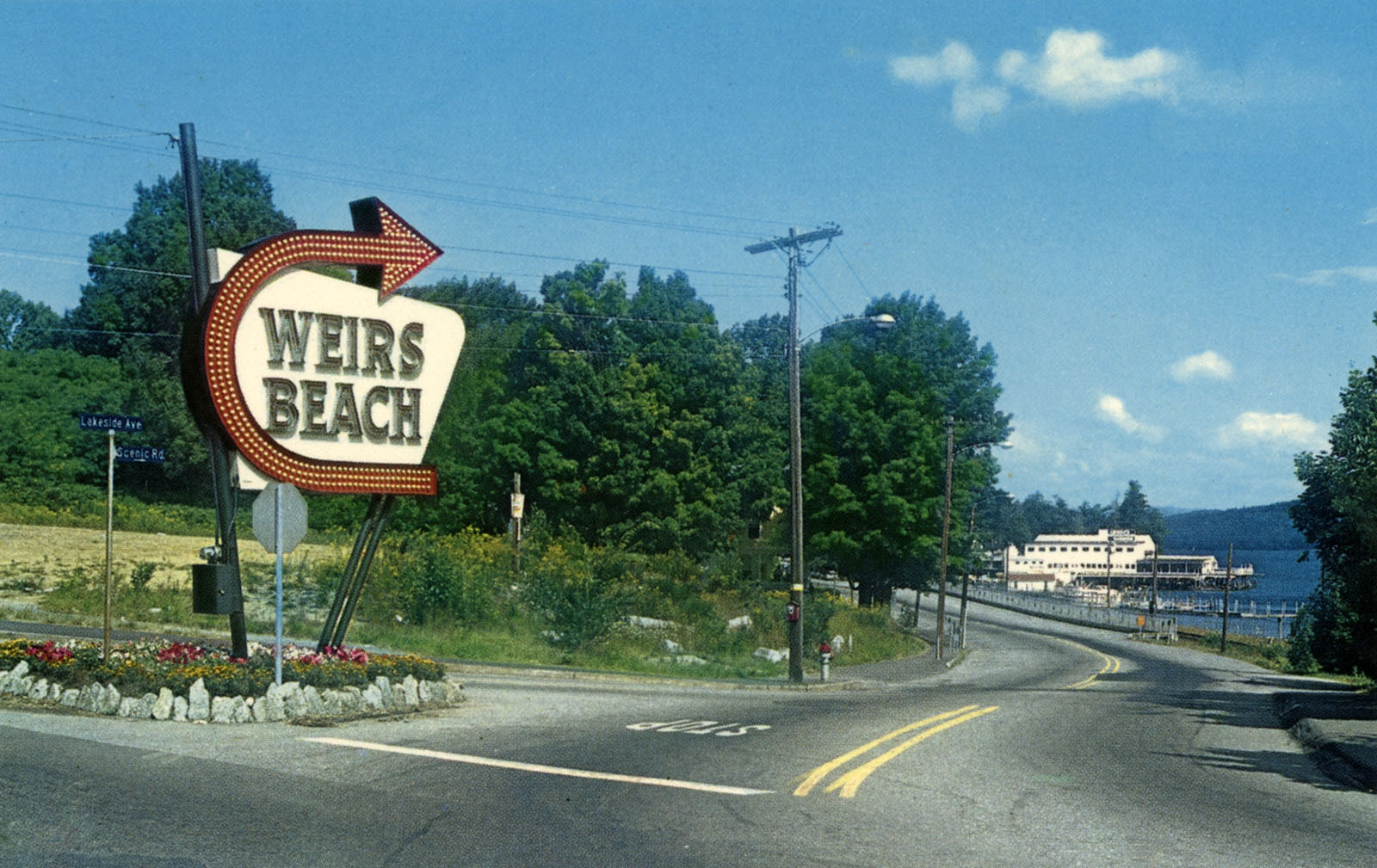
A similar photo to the above photo of the original Weirs Beach Arrow sign, taken from a slightly different angle. Interestingly, the prime property at the corner of Lakeside Avenue and Route 3 is vacant and overgrown in this photo.
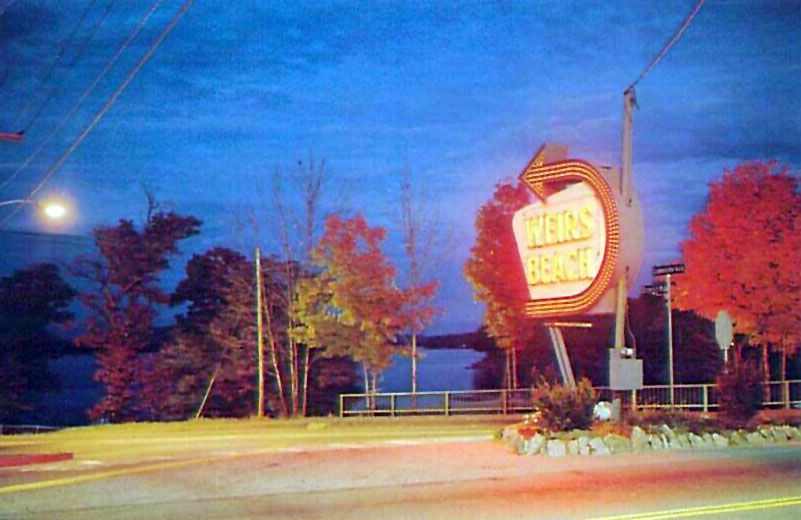
The original Weirs Beach Arrow sign on a fall night, circa the 1970s, looking towards the lake. In this photo, while the sign is still the original yellow, the arrow and poles appear to be painted gray, and the neon appears to be neon yellow instead of the original neon red. It is probable that these are false colors due to photographic manipulation to make the Arrow visible at night.
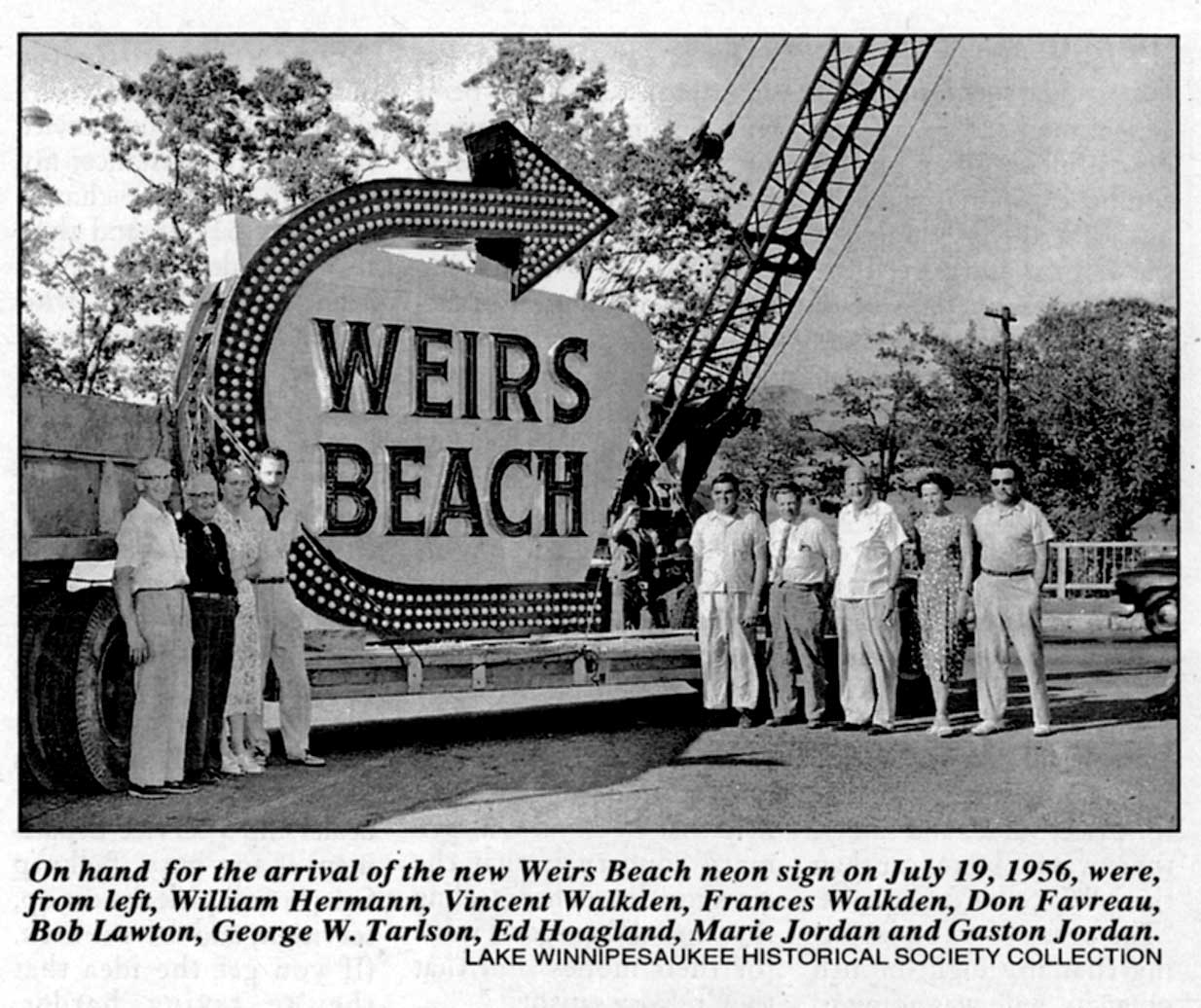
Captioned B&W photo of the sign’s original installation in 1956. The people in the photo can be identified as follows. George W. Tarlson: built his Tarlson’s Arcade building in 1950. Building still extant, now the Tower Hill Tavern. Vincent & Francis Walkden: owned a gift shop at the Tarlson’s Arcade building. Bob Lawton: owned the Weirs Sport Center atop the Tarlson’s Arcade building. Ed Hoagland: owned the Lakeview Hotel, still extant. Marie & Gaston Jordan: owned the Park View hotel, originally the Aquedoctan; burned down in 2010. Don Favreau: along with his Dad, Alberic, owned the Lakeside Hotel, now the Winnipesaukee Marketplace. William Hermann: proprietor of the Broadview, a waterfront inn that was located on the Shore Path at 24 Baker Ave, now condos.
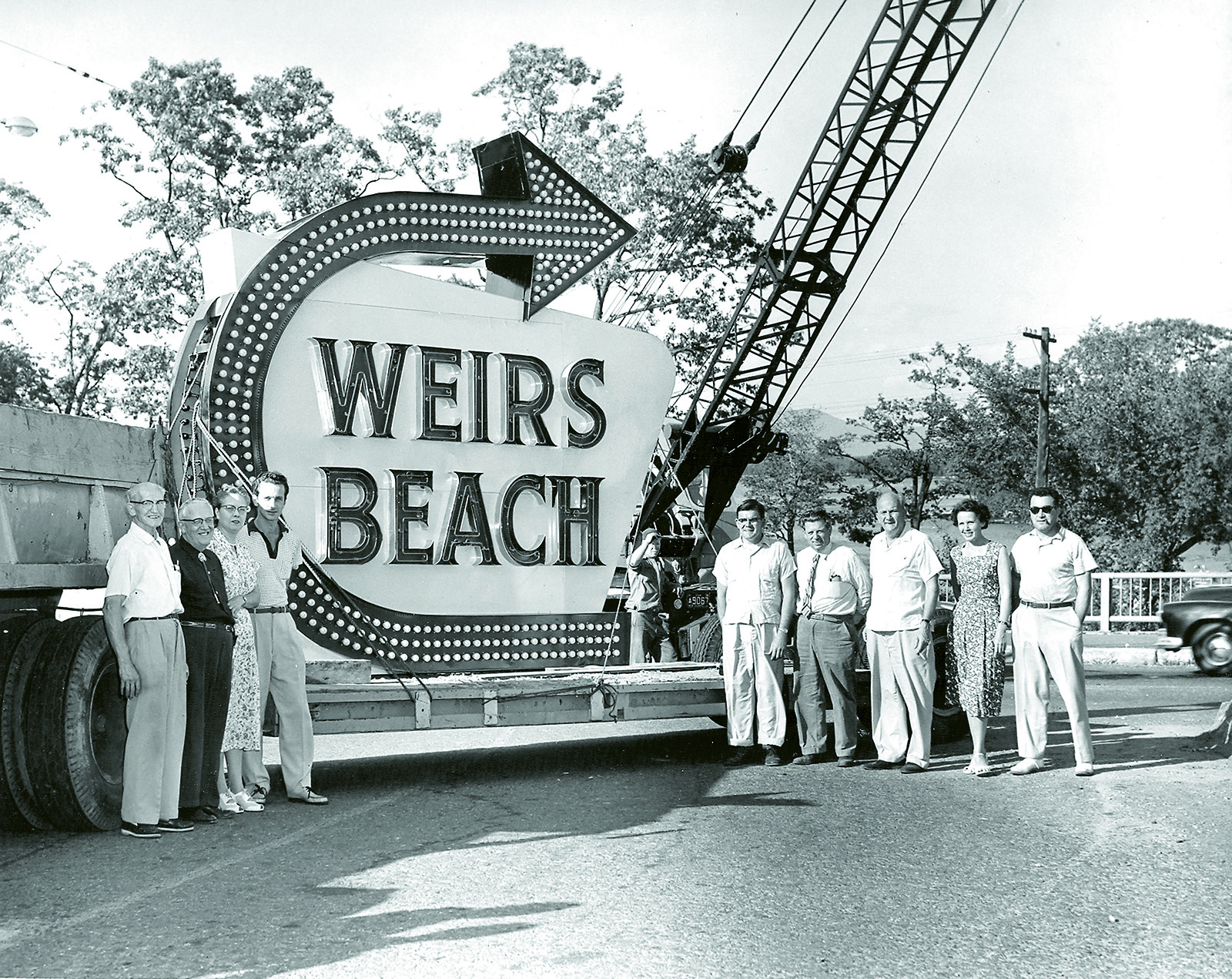
Hi-res version of the captioned photo
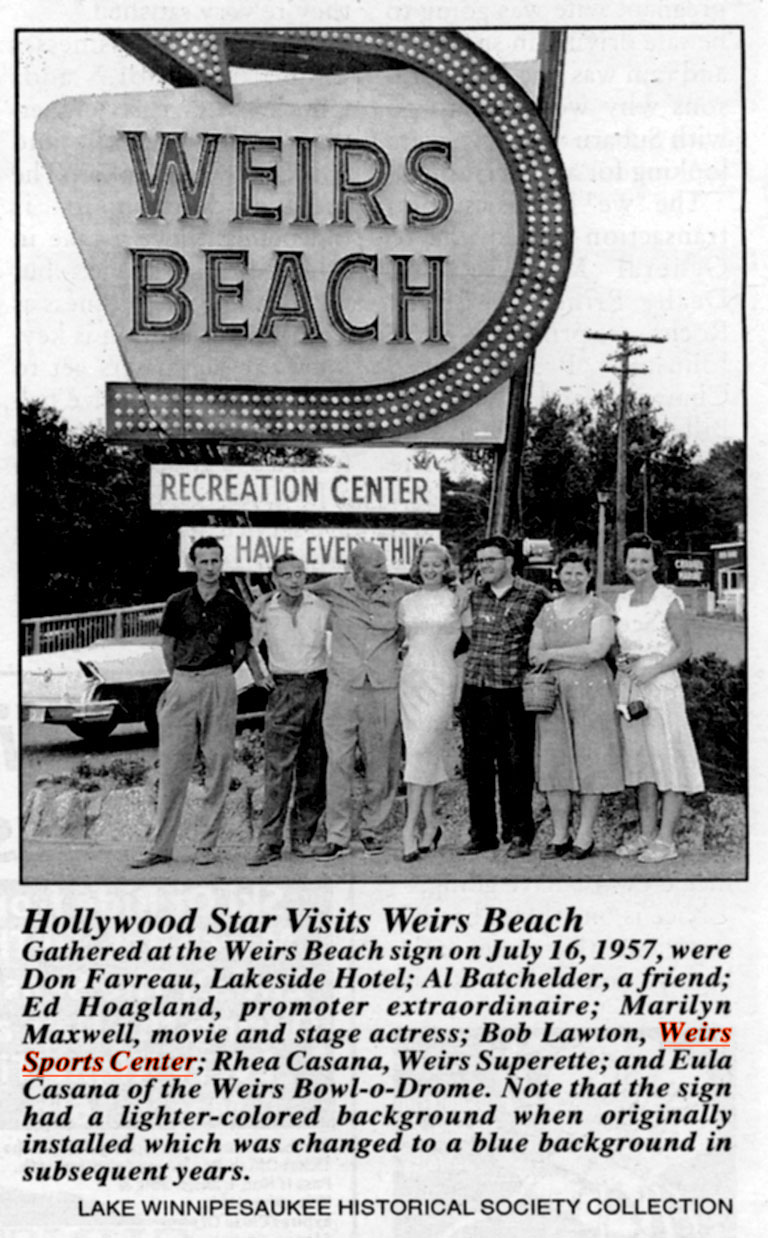
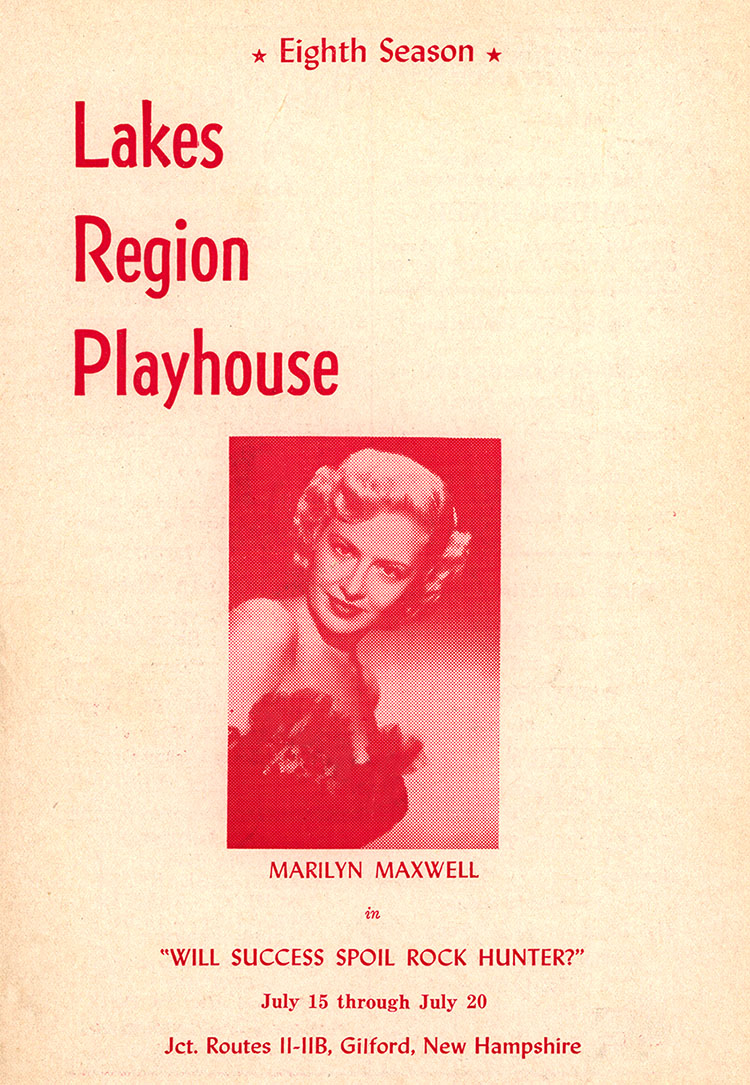
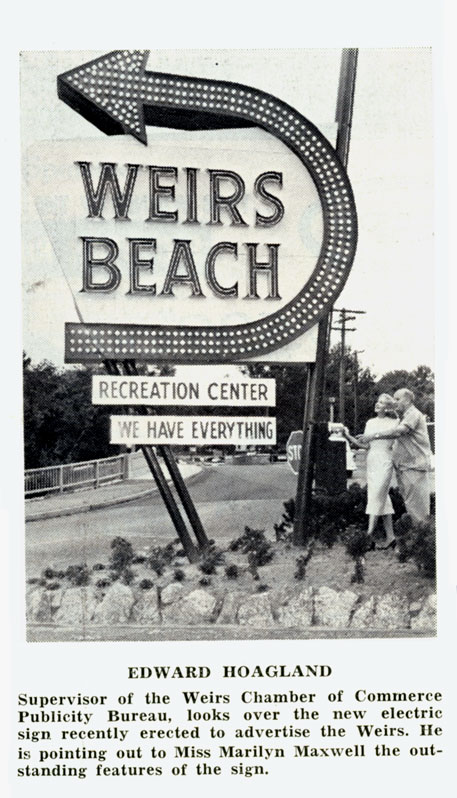
The one year anniversary of the sign in 1957. Hollywood star Marilyn Maxwell joins the festivities. Maxwell was performing nearby at the Lakes Region Playhouse at the time of the photo, and was invited to participate. Hollywood stars performed on a regular basis at the Playhouse.
Program cover from Maxwell’s 1957 appearance at the Lakes Region Playhouse. She was appearing in the play “Will Success Spoil Rock Hunter?“. The play was made into a movie starring Jayne Mansfield and Tony Randall. The movie was released on July 29, 1957, only about a week after Maxwell’s Lakes Region appearance.
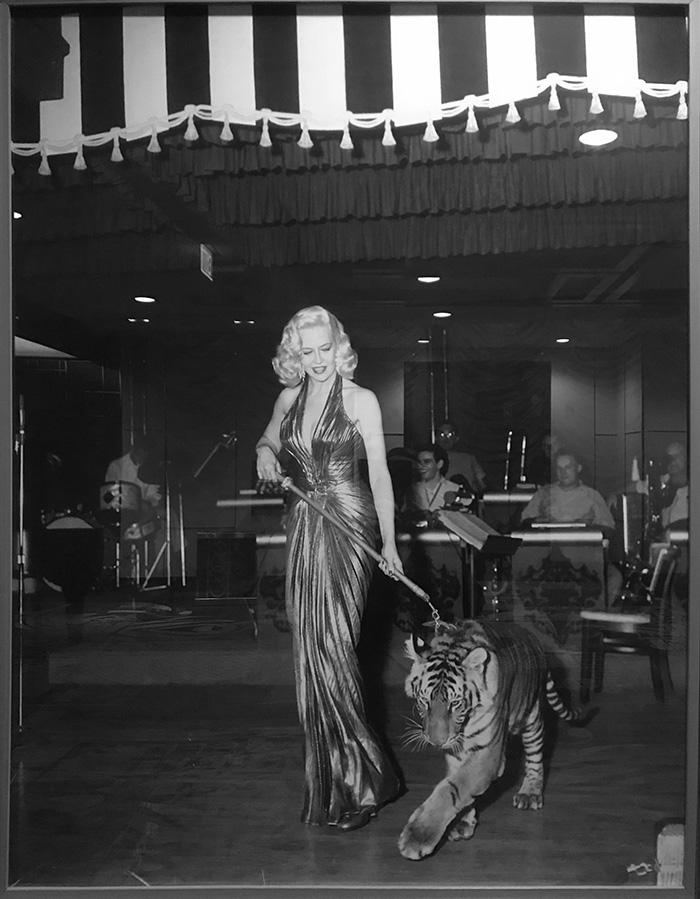
The following photo appeared in the 1958 official program for Motorcycle Week. The photo, taken the year before, once again features Hollywood star Marilyn Maxwell.
Circa the 1980s, the sign colors had changed, from the original yellow-and-black, to a light blue sign, dark blue poles, and a red arrow. Upon restoration in 2002, the sign kept the 1980s color scheme.
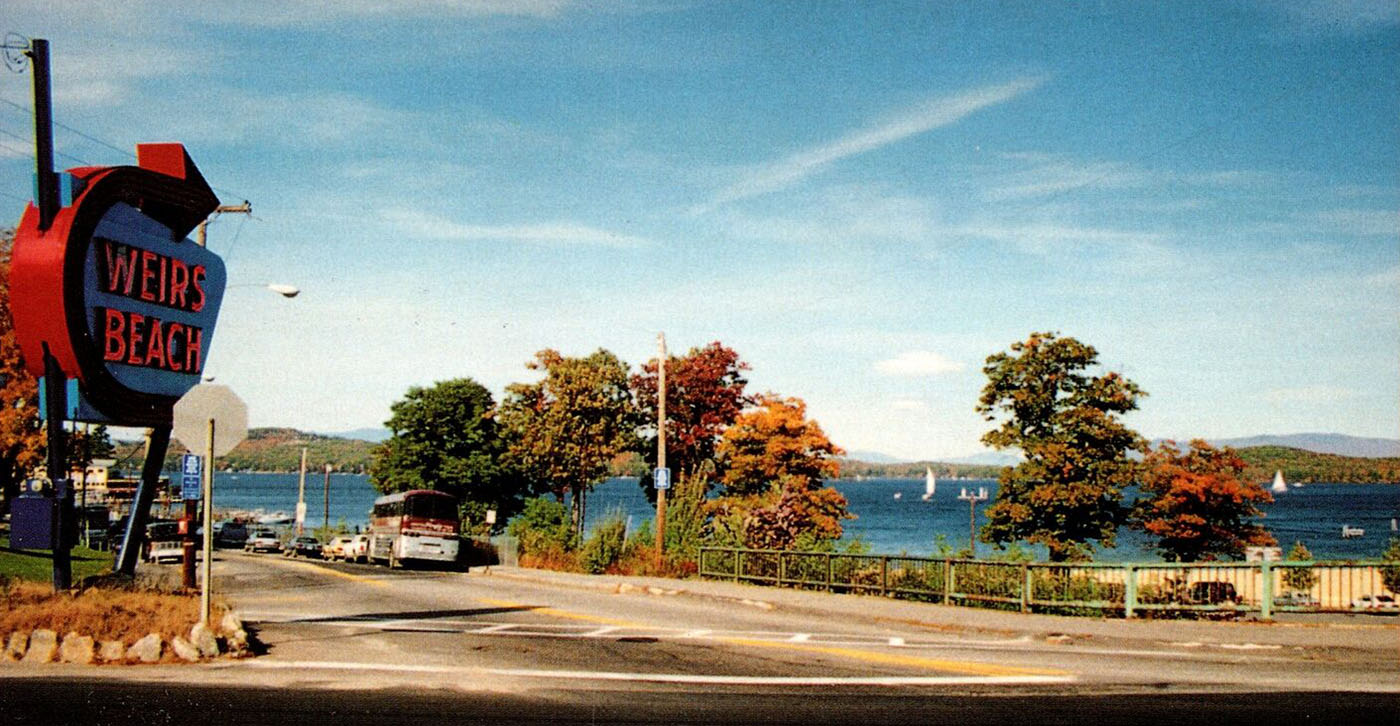
1998 photo
A 2026, nightime photo of the sign.
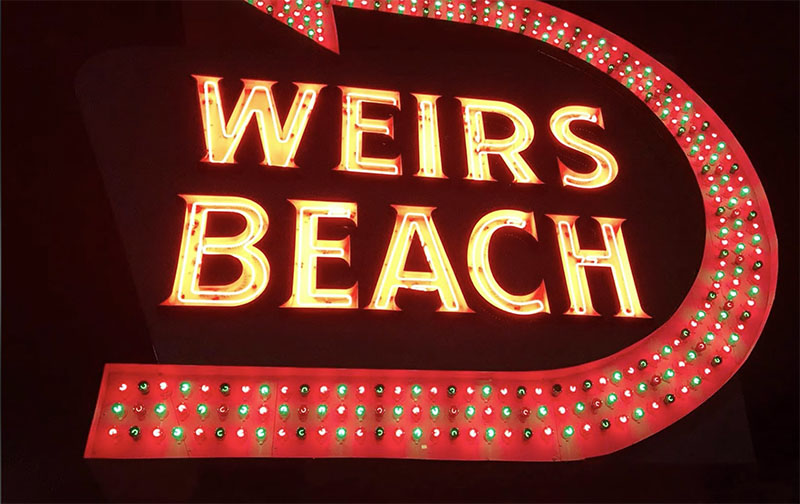
For six winter seasons, from the 2018-2019 winter through the 2023-2024 one, the sign was turned on briefly for the Holidays, from late November until early January, with the yellow light bulbs being temporarily replaced by red and green ones.
Captioned “Now” photo of the sign, which appeared on the front page of the July 18th, 2026 issue of the Laconia Daily Sun. The photo was used in a “Then and Now” section of the newspaper contrasting the 1956 photo above to the 70th anniversary celebration of the sign.