







Governor’s Island
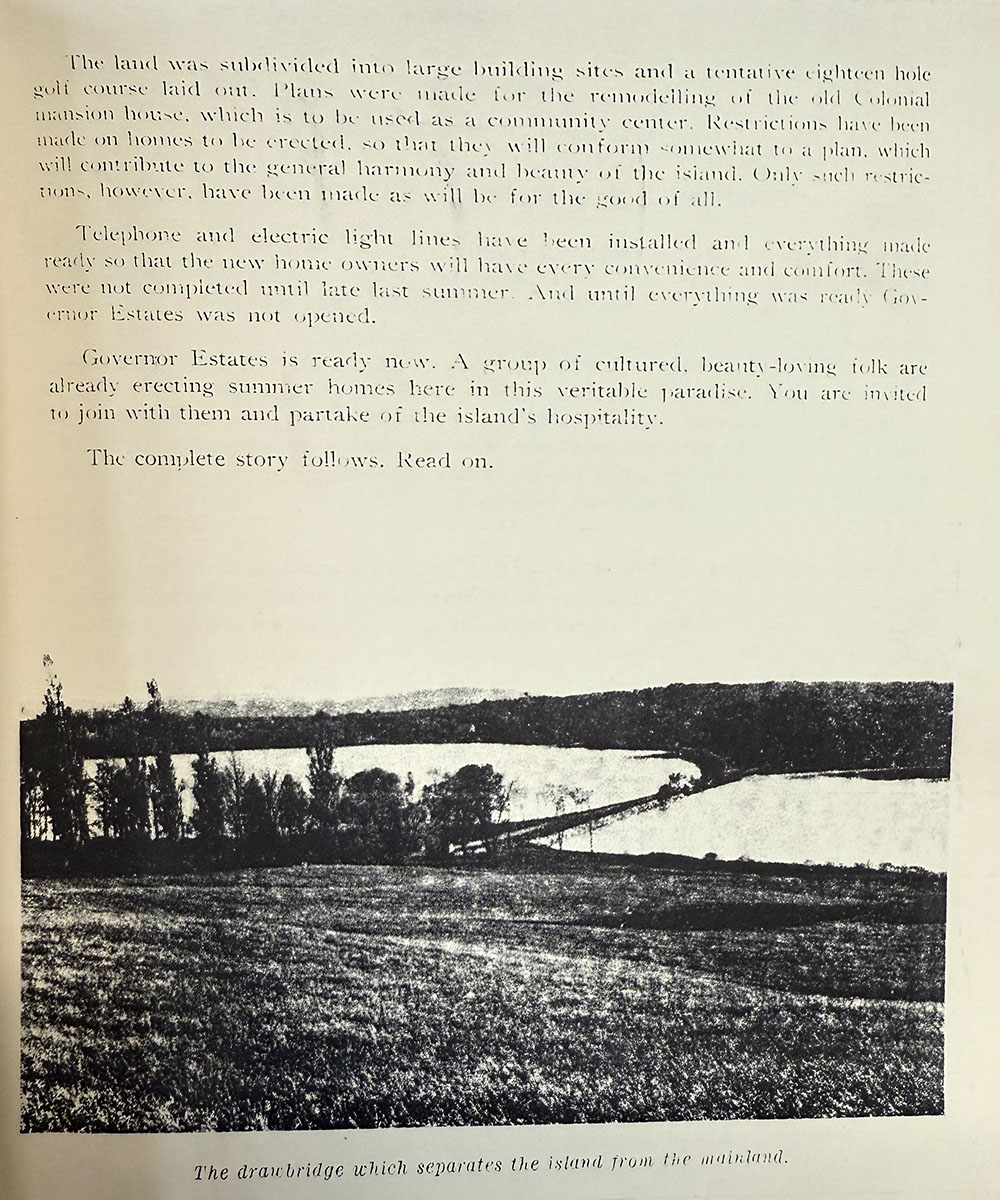
The Governor’s Island Bridge
The Summit Avenue bridge to Governor’s Island (062/077) spans the Laconia-Gilford line. The current bridge dates to 1981 with repairs in 2020.
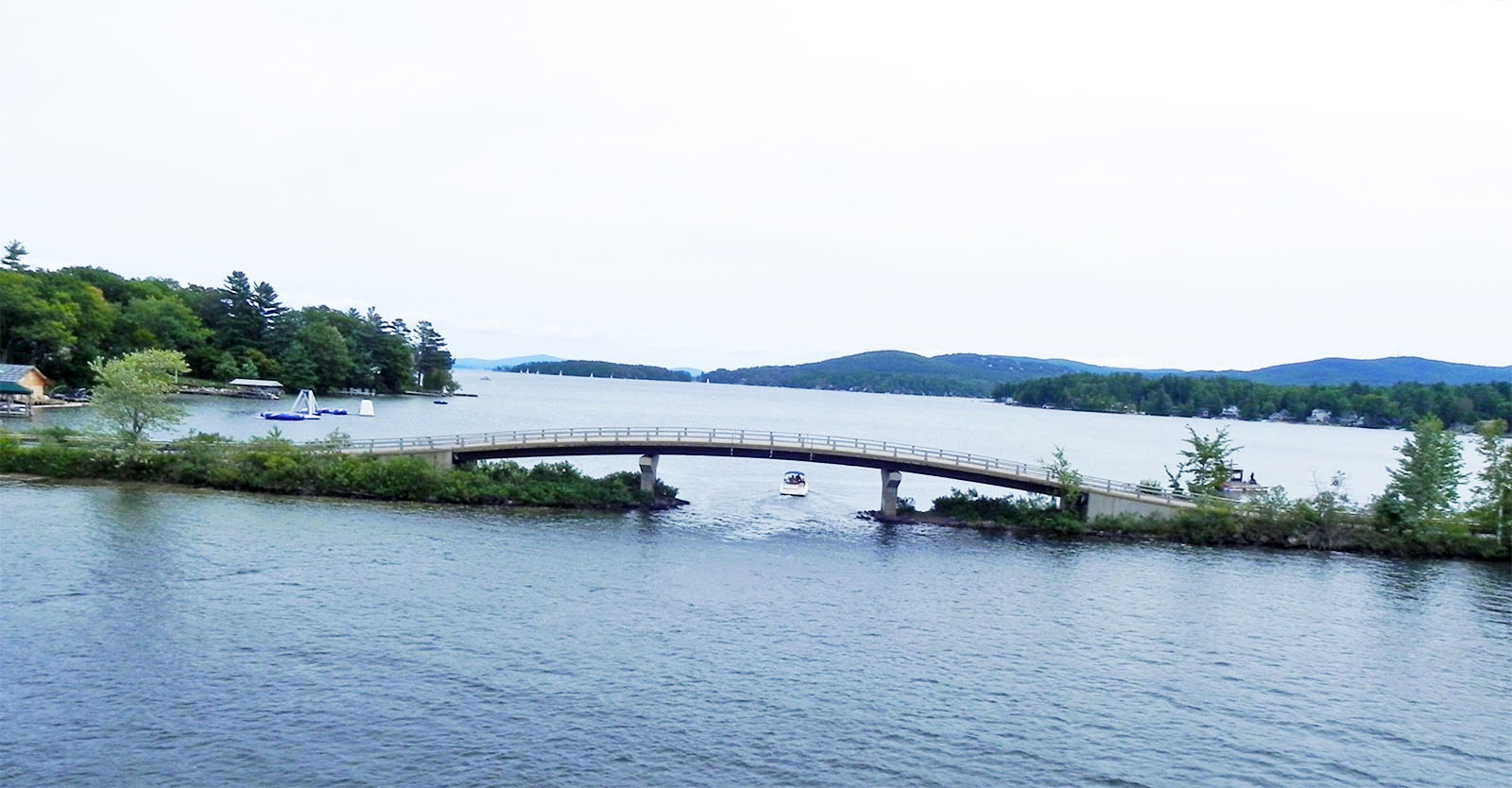
The first bridge to Governor’s Island was built in 1820. The Reverend J.P. Watson, in his “History of Gilford” chapter, from the 1885 “History of Merrimack and Belknap Counties”, pg 754, states that “The bridge leading to Governor’s Island was built in 1820, and mainly by the owners of the island. Its support being expensive, they asked the town’s support of it, and the town at length assumed it. It was built by sinking a structure of logs in square sections and filled with stone, the greatest depth being about twenty-five feet, and there is left an open pass-way, not in the deepest part of the channel, of some fifteen feet width, through which row-boats, if small, may pass. The filling of stone on each side of the bridge renders it enduring against the action of the waves.”
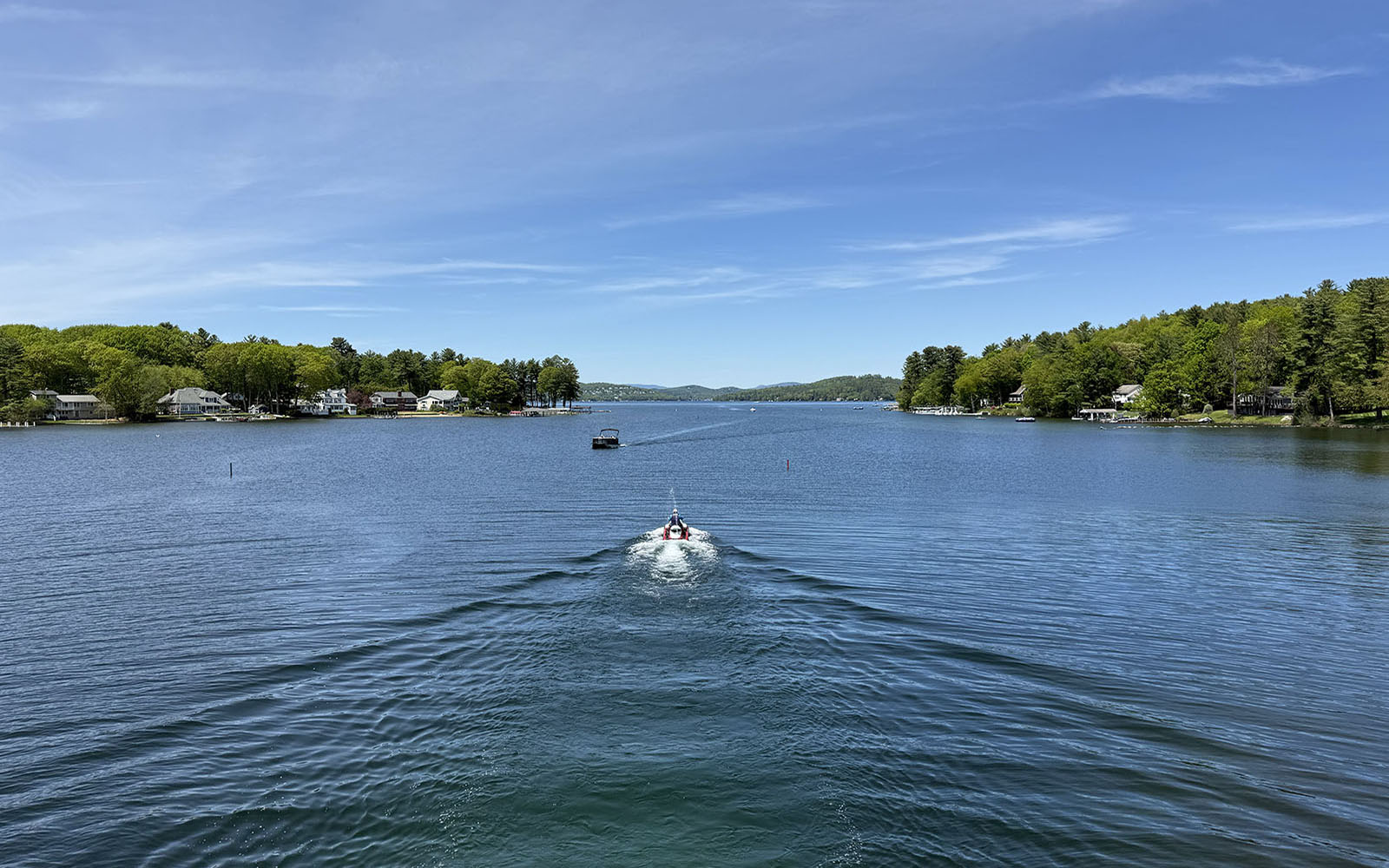
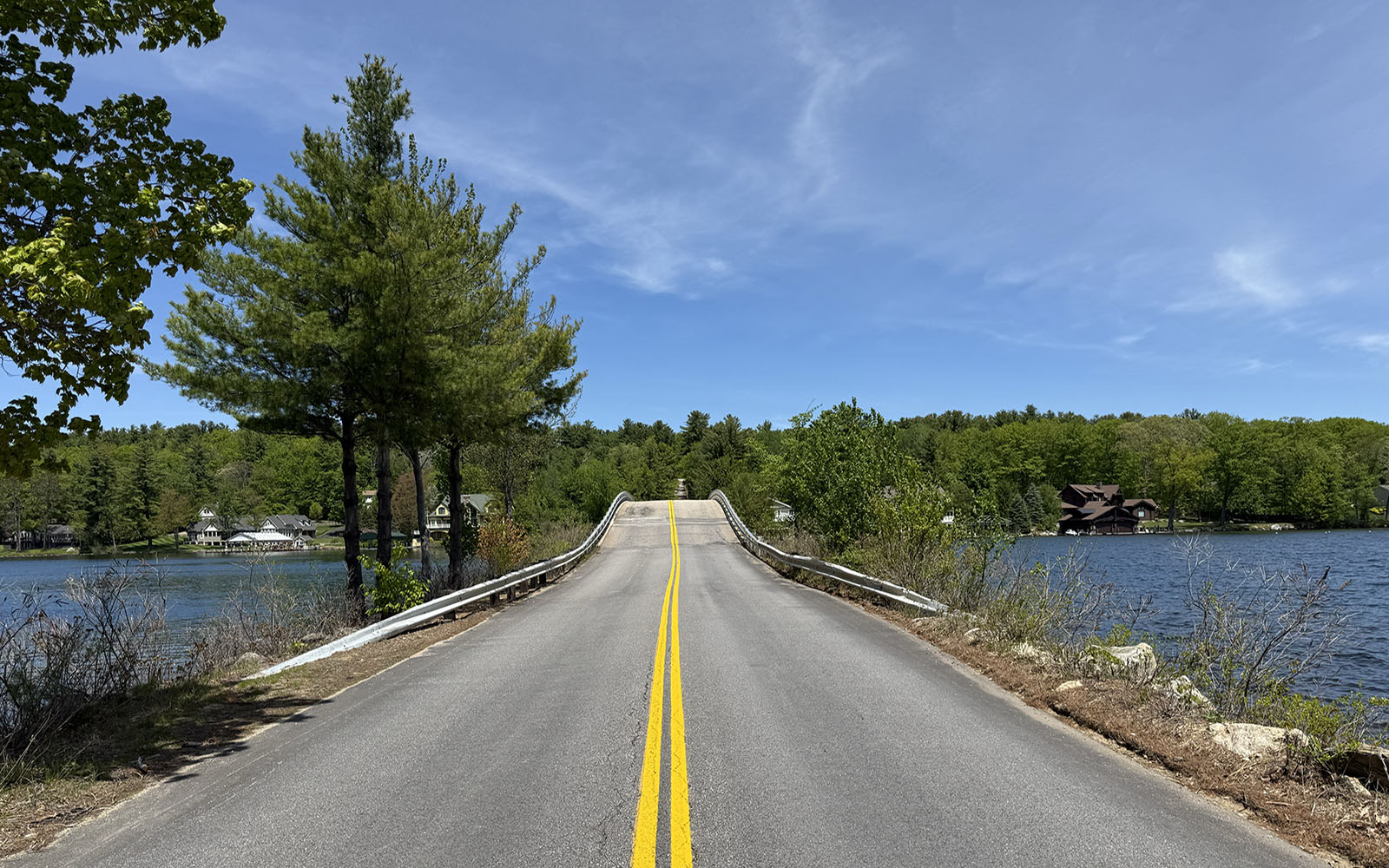
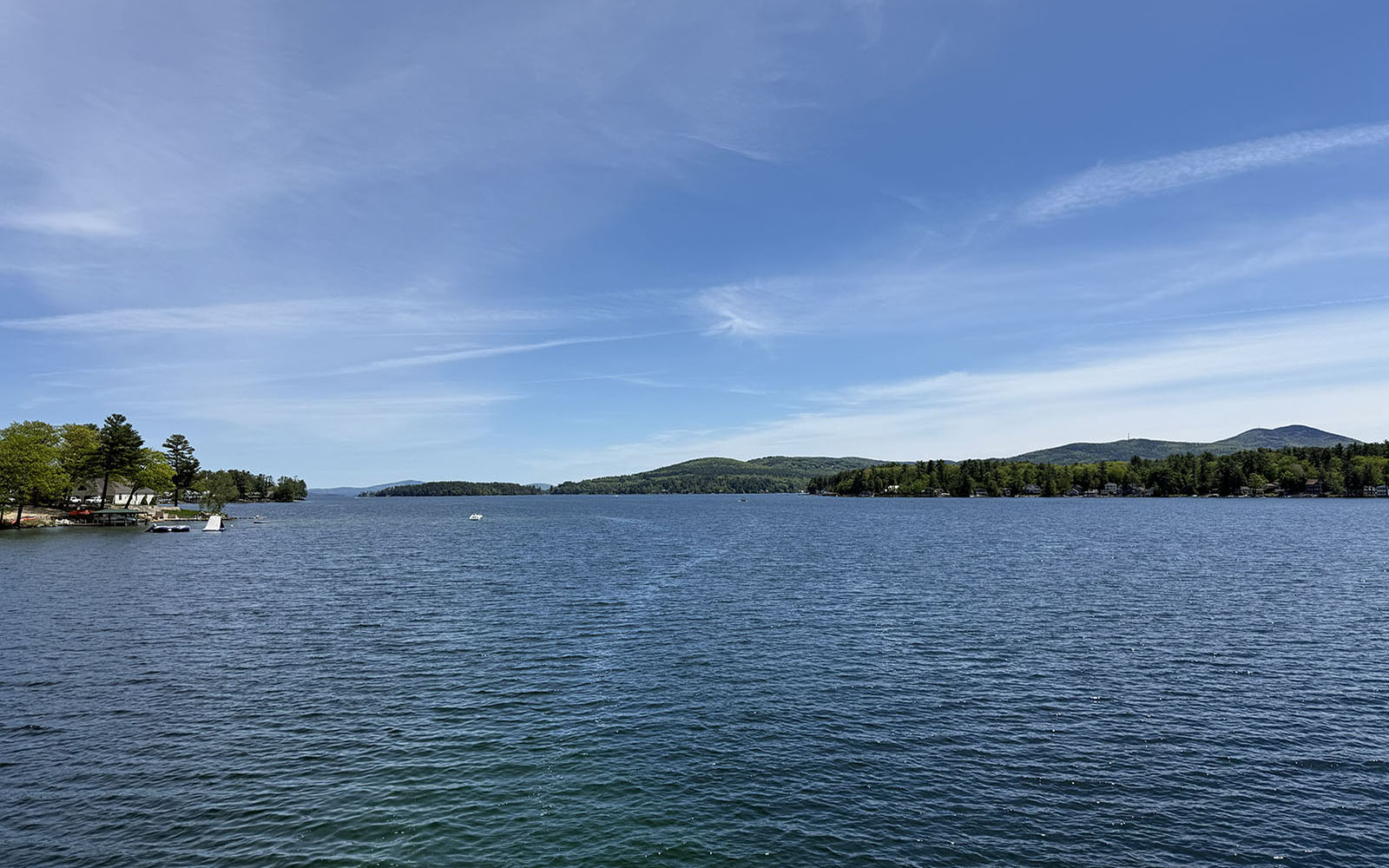
View from the bridge to the west towards Weirs Bay; the bridge roadway to the island; view from the bridge to the east towards the Belknap mountains.
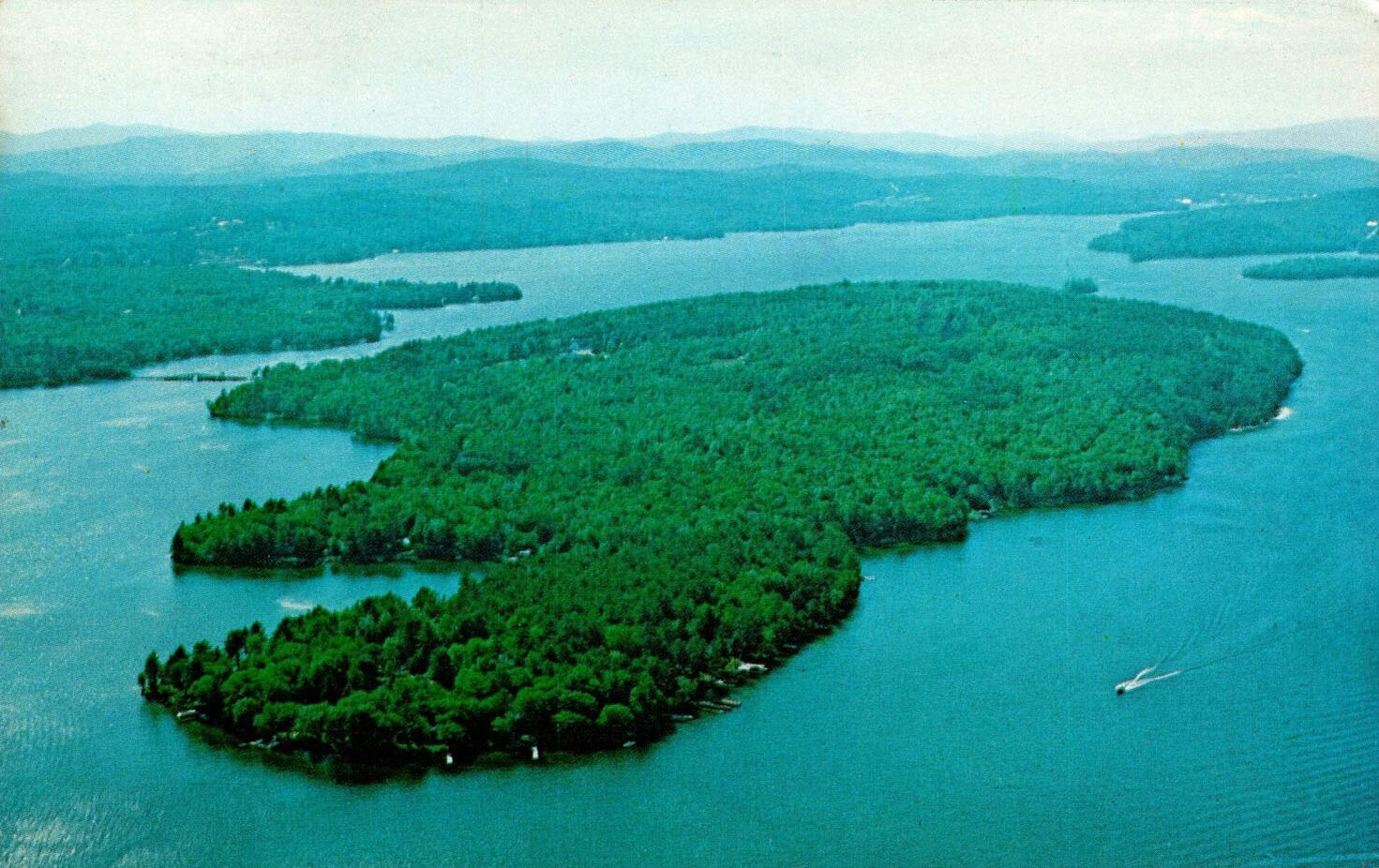
A 1977 aerial photo of Governor’s Island. The view is northwest towards Weirs and Meredith bays. The bridge connecting the island to the mainland can be seen on the left side of the aerial.
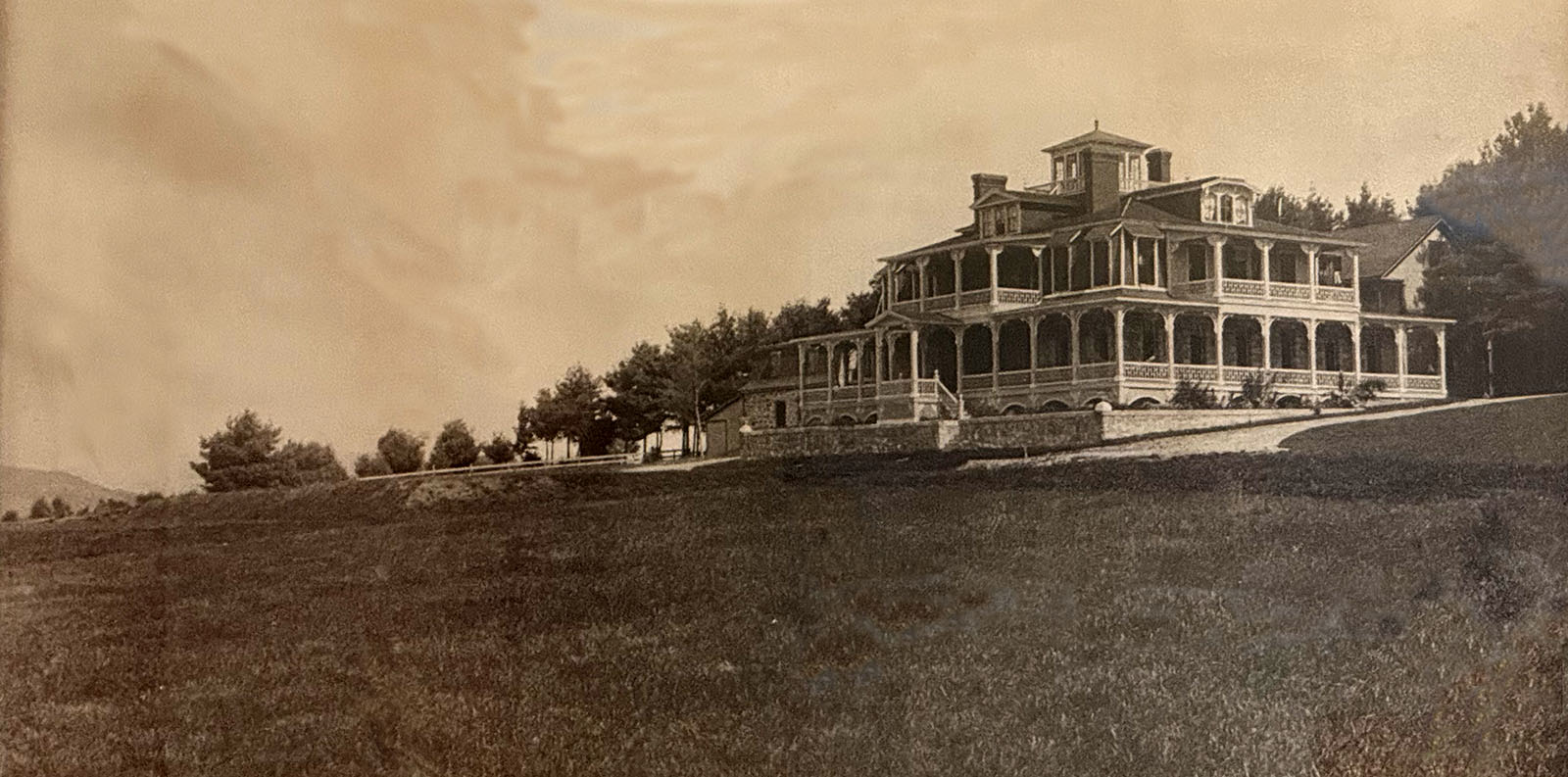
The Stilson Hutchins Mansion
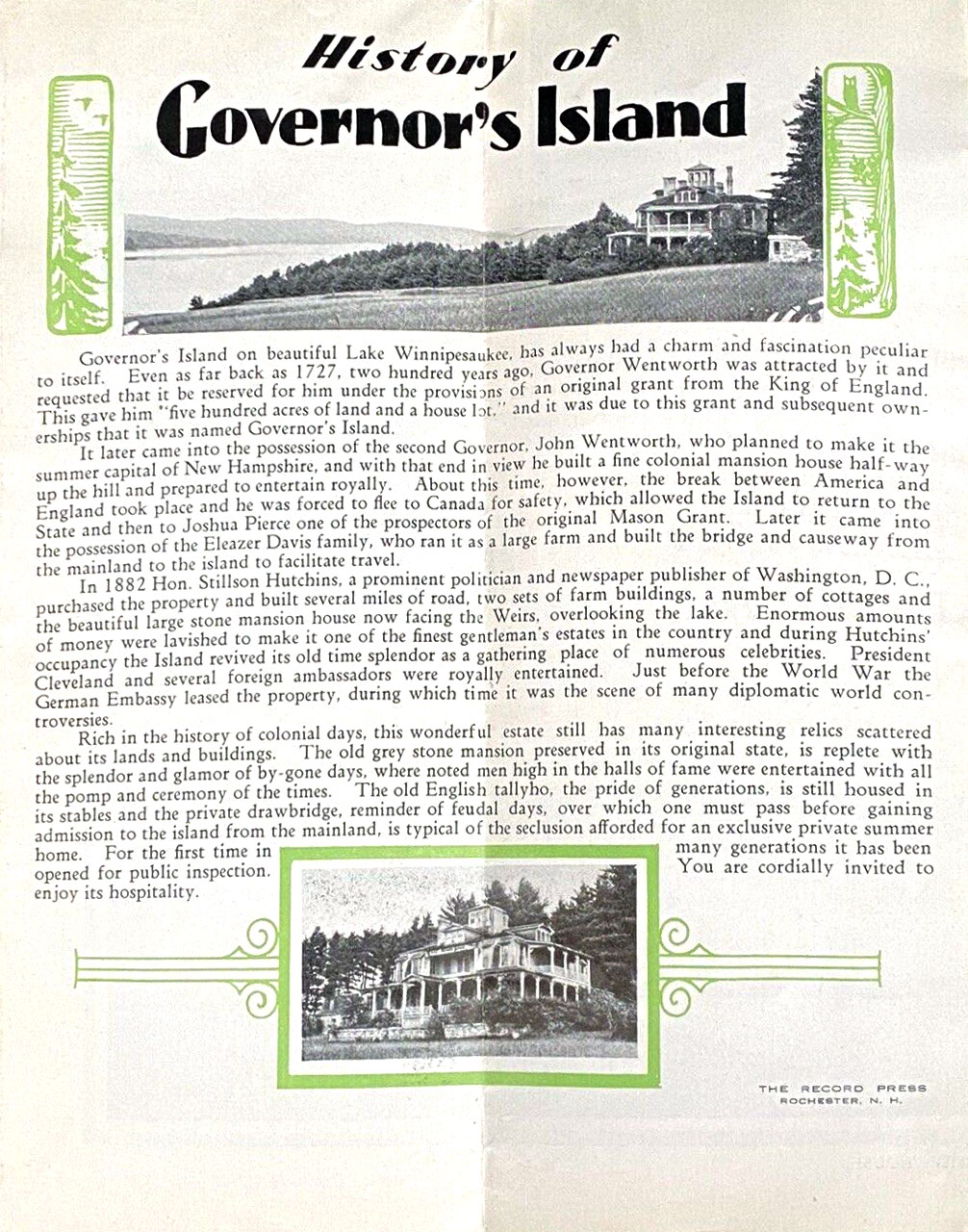
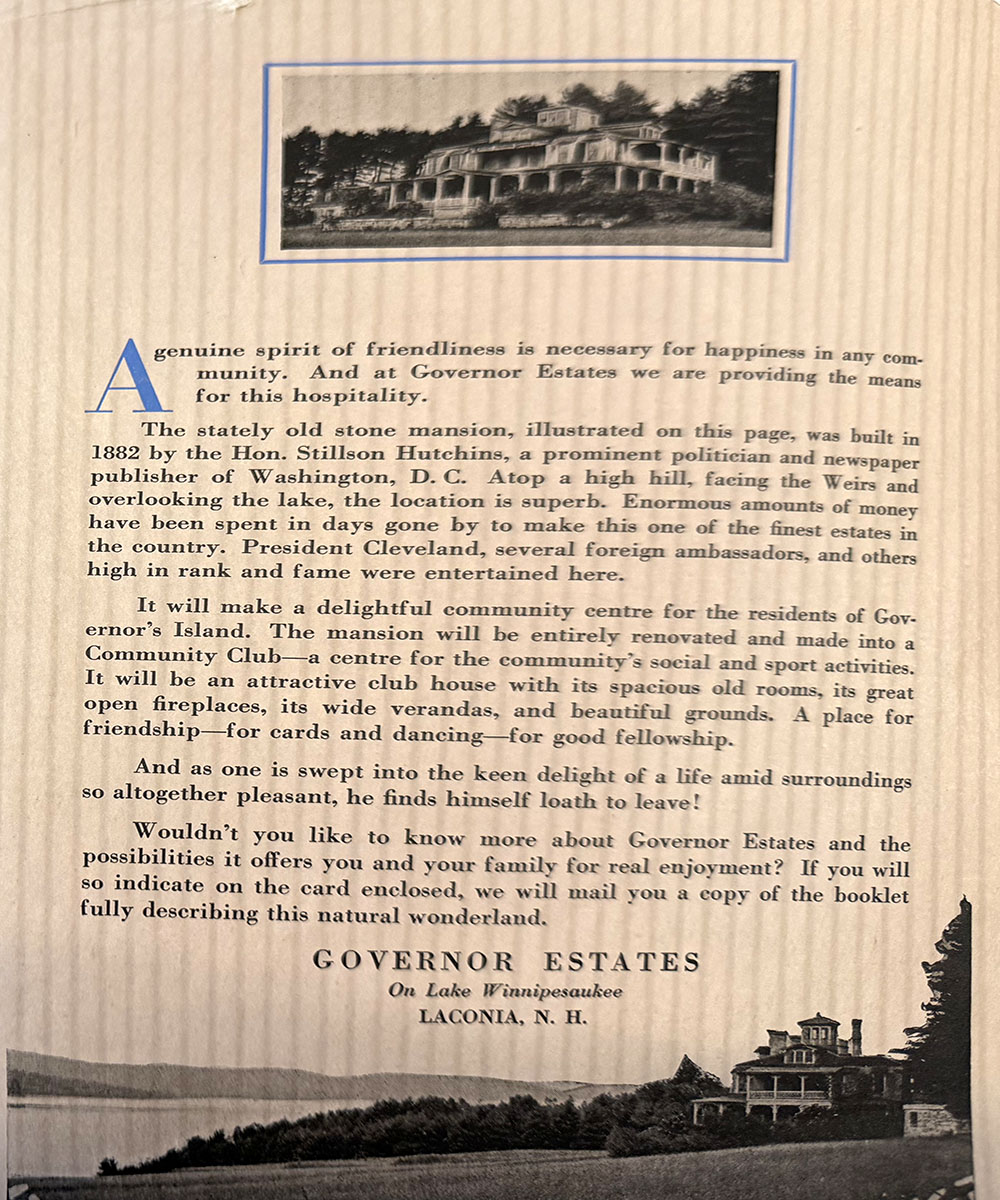
The Stilson Hutchins mansion was the largest house on Governor’s Island from 1885 until the 1928, Governor Estates development (see below). Stilson Hutchins was the founder of the Washington Post newspaper. In 1882, Hutchins bought the island and built the elegant grey stone mansion. The mansion is seen in numerous historical postcards, sitting alone in a large field, and facing directly towards Weirs Beach. Many well-known politicians and dignitaries stayed there during its heyday. The mansion burned down on August 1, 1935.
In an 1893 railroad timetable, Chas E. Sleeper, proprietor of the Hotel Sanborn (Hotel Weirs), refers to himself as also the manager of the elegant new “Terrace Hall” on Governor’s Island. This undoubtedly referred to the mansion, and indicates the mansion was available to rent.
According to Harlan E. Wilcomb, writing in 1923, “The late George von L. Meyer, former ambassador to Italy and Russia and member of the Roosevelt and Taft cabinets, established his summer residence on the island while connected with administrative affairs at Washington, during which time the locality became the mecca of distinguished people from all parts of the world and was the scene of numerous brilliant social affairs, especially during the Japan-Russia peace parley at Portsmouth….Ambassador Baron von Speck and the German Embassy occupied the mansion for a season before the World War.” (Actually, von Speck rented the mansion for several seasons during his 1903-1908 ambassadorship, and conducted the affairs of the German Embassy from there during the summertime.)
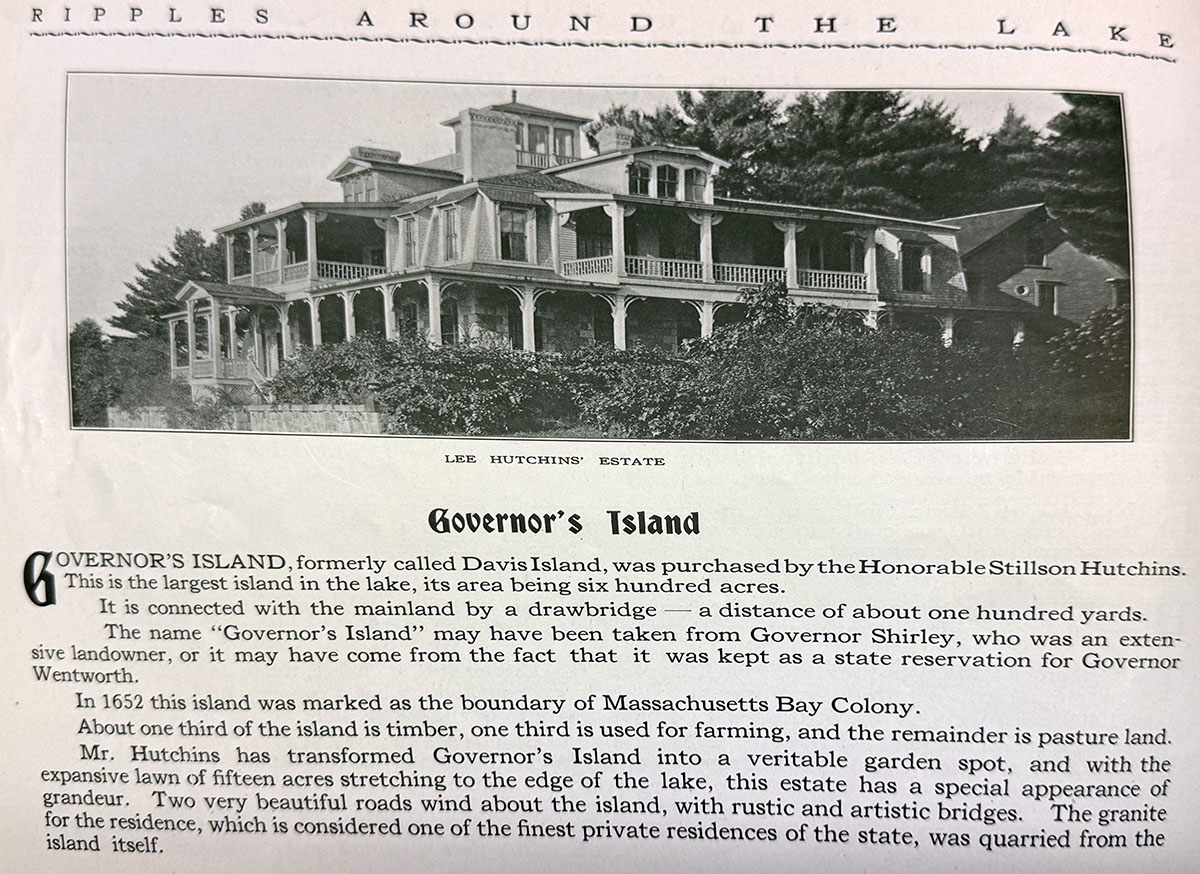
Article about Governor’s Island from “Ripples around the Lake”, a weekly magazine published during the summer of 1919. The photo caption attributes ownership of the mansion to the Lee Hutchins’ Estate. Lee Hutchins was one of Stilson’s two sons; Stilson had passed away in 1912.
Davisville
Eleazer Davis, an Alton farmer, bought Governor’s Island in 1799 when it was still completely forested. His son Natt Davis became an adherent of the Millerite religious movement and the island was partly developed, becoming a focal point of the movement. During this phase the island became known as Davis Island. After the “Great Disappointment” of the movement occurred in 1845, the island was gradually abandoned. In 1857, the island was sold by the Davis heirs. For the next 23 years, the remaining buildings were neglected and allowed to go to ruin. In 1880 Stilson Hutchins bought the island and began his improvements.
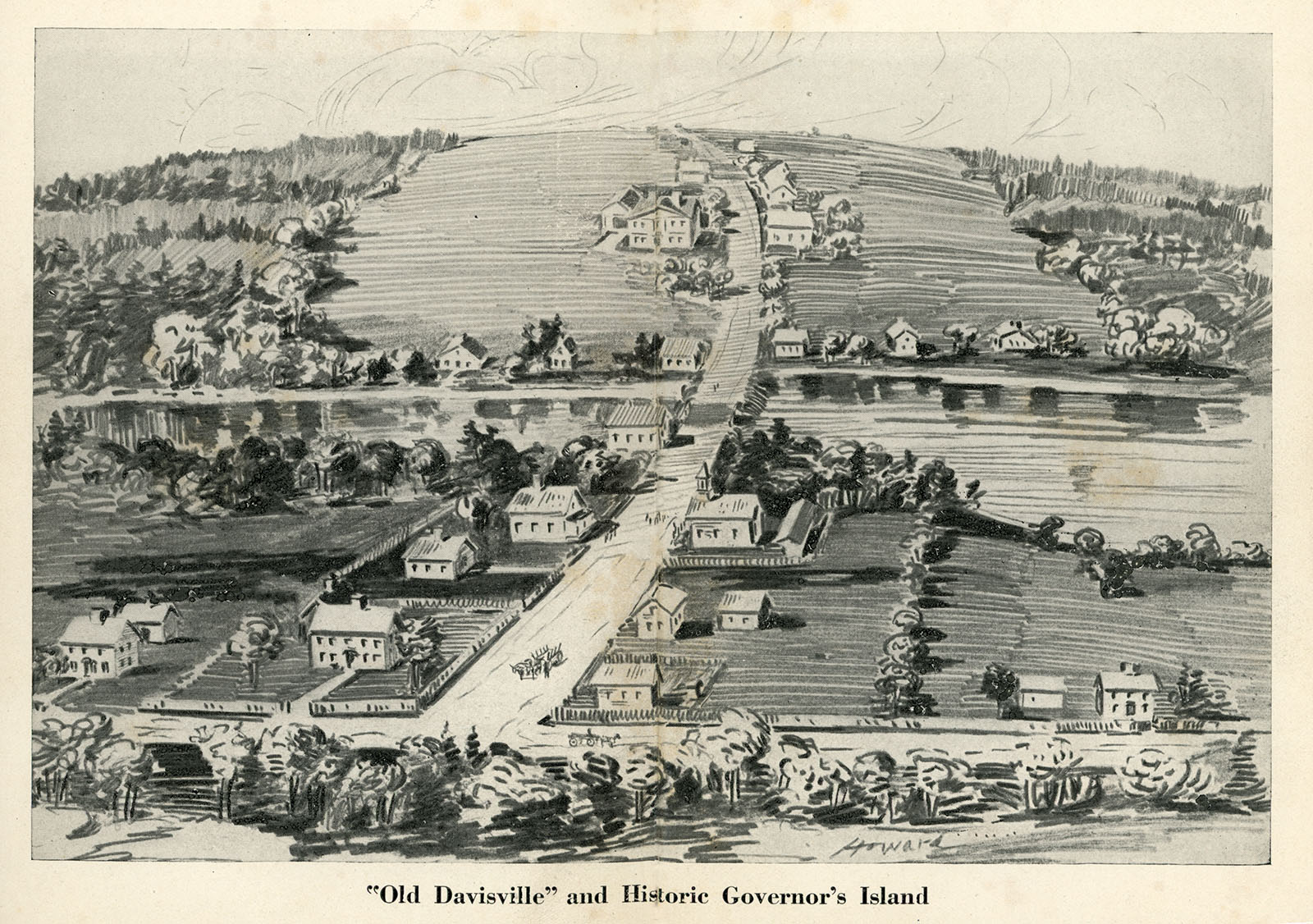
A sketch of “Old Davisvlle”, from Edgar H. Wilcomb’s 1923 booklet, “Old Davisville and Governor’s Island”, shows a part of the island, a part of the mainland, and the island bridge. The sketch was produced from Wilcomb’s memory of the scene, not from a photo.
Governor Estates Brochure
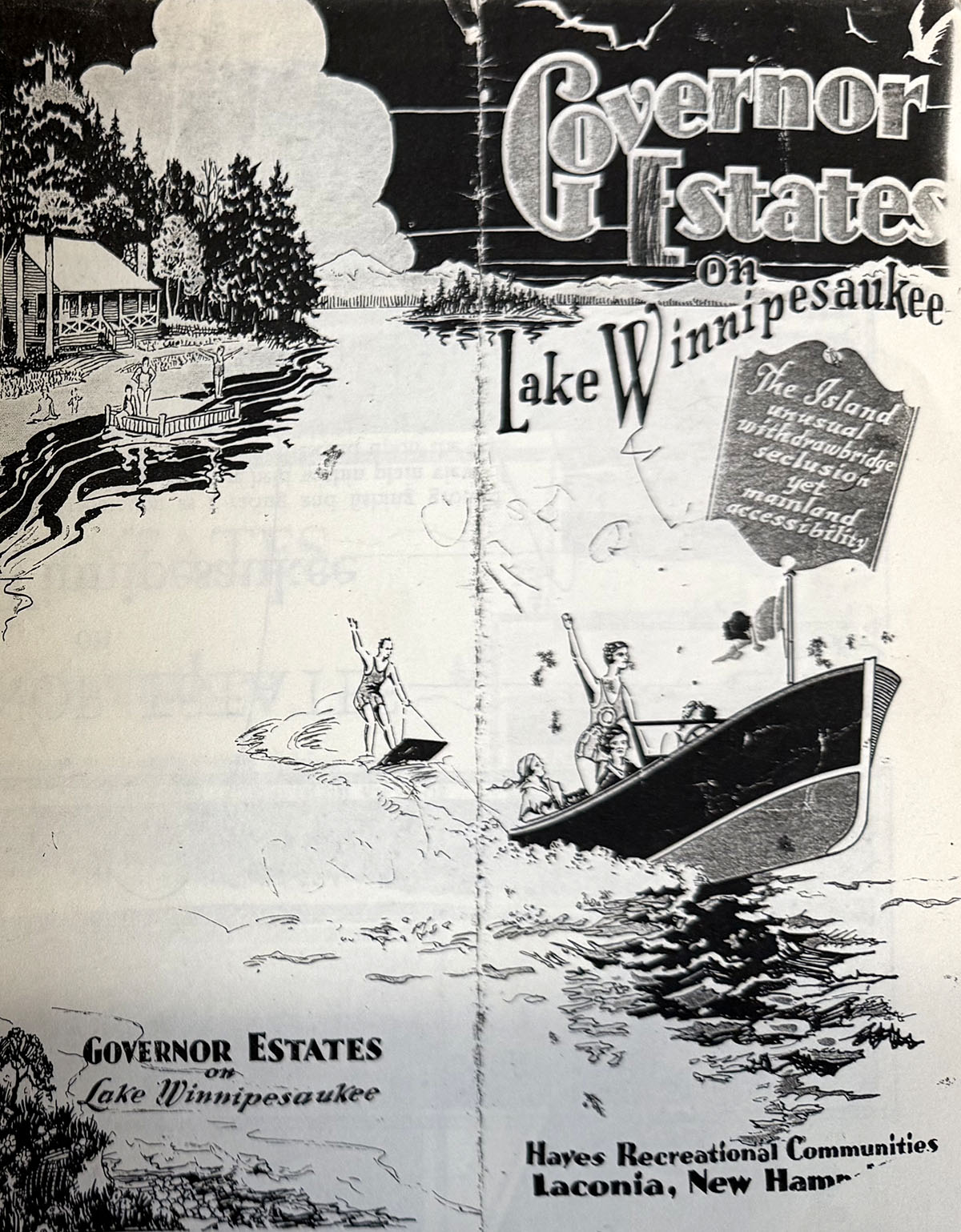
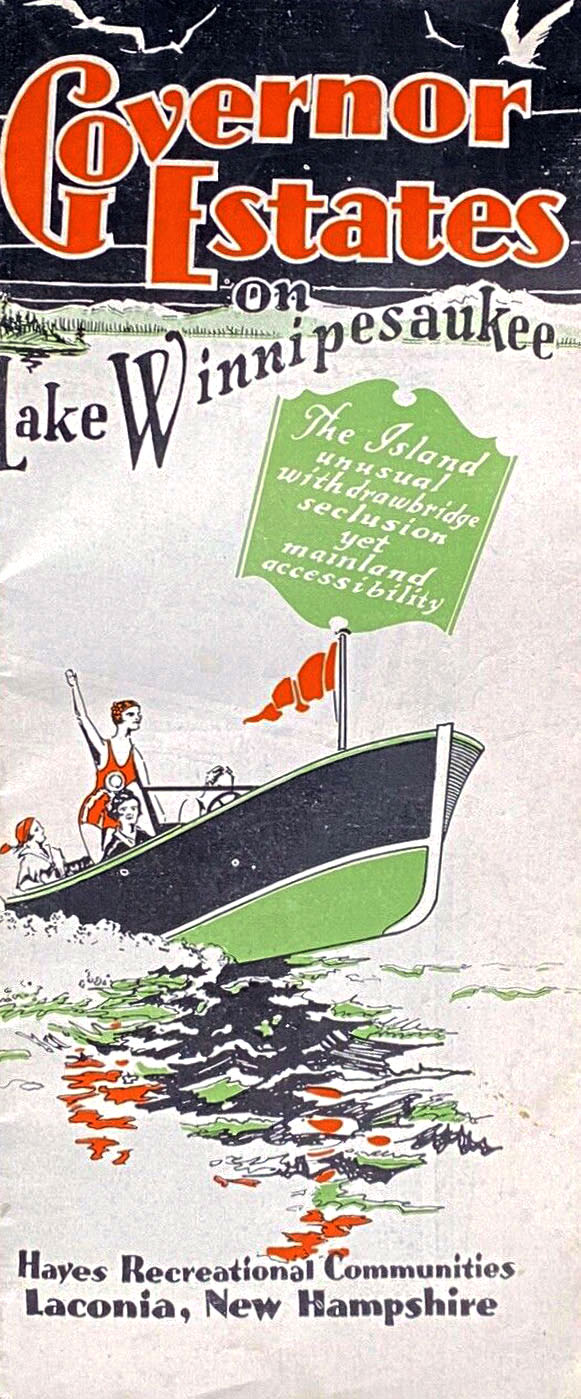
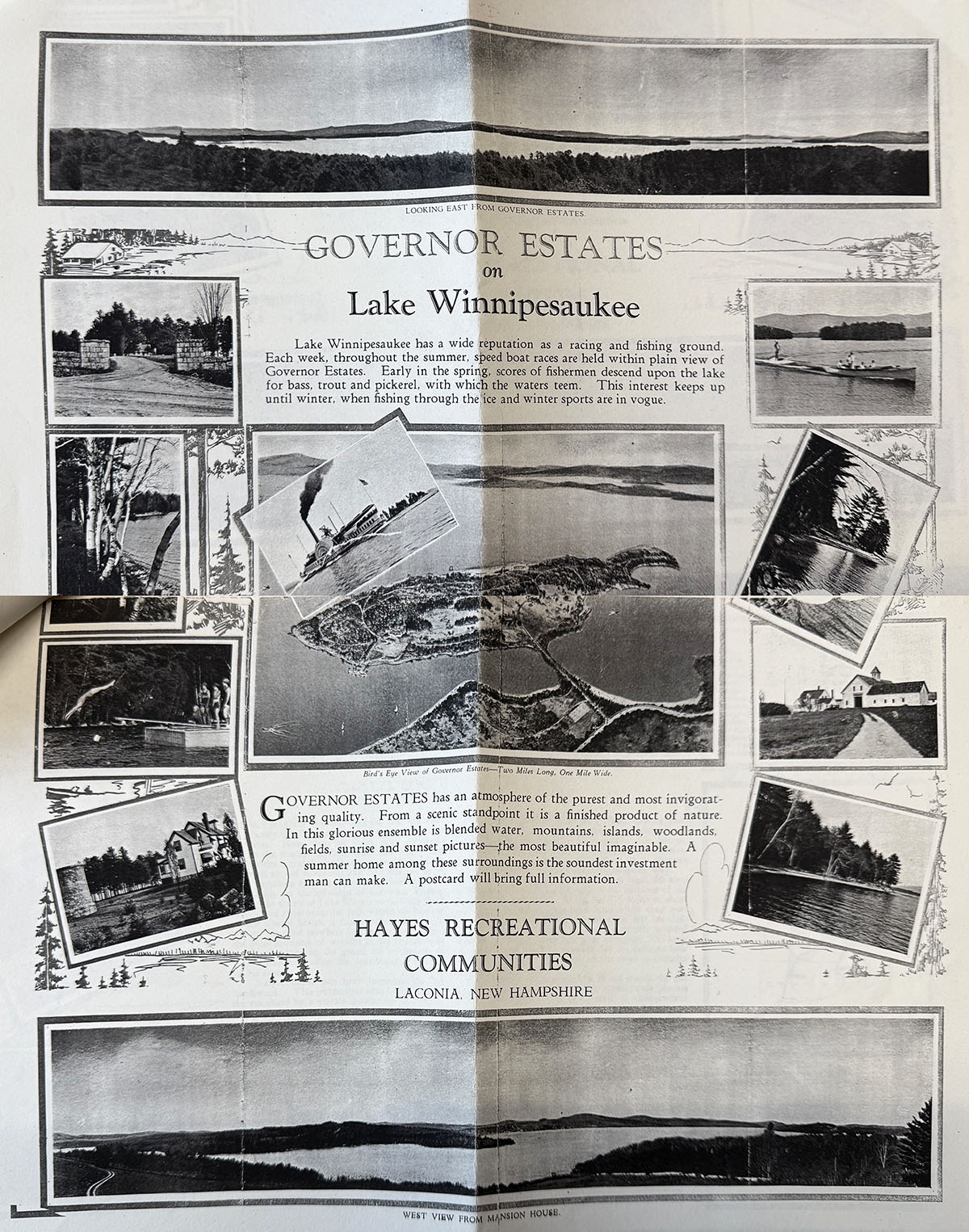
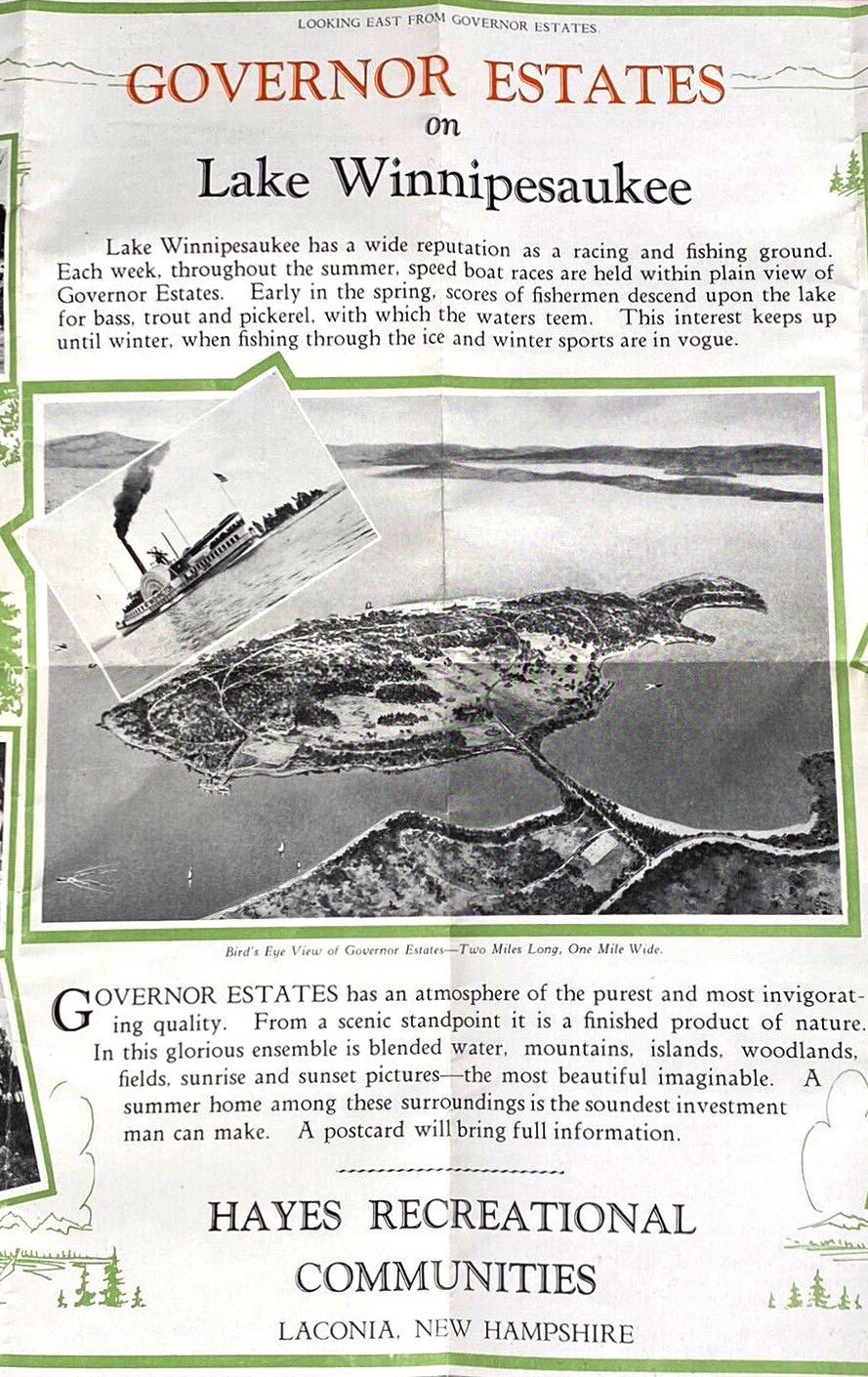
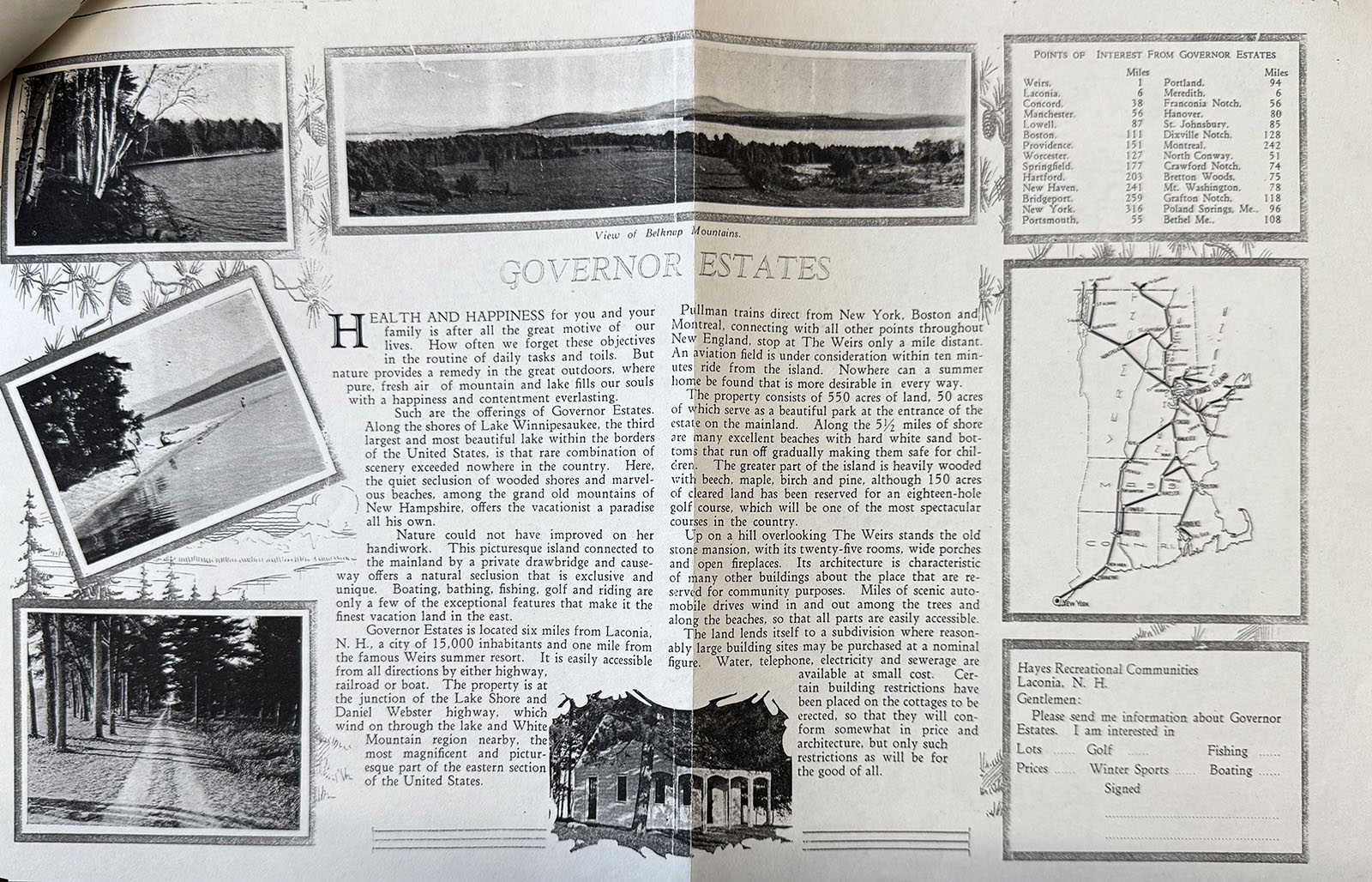
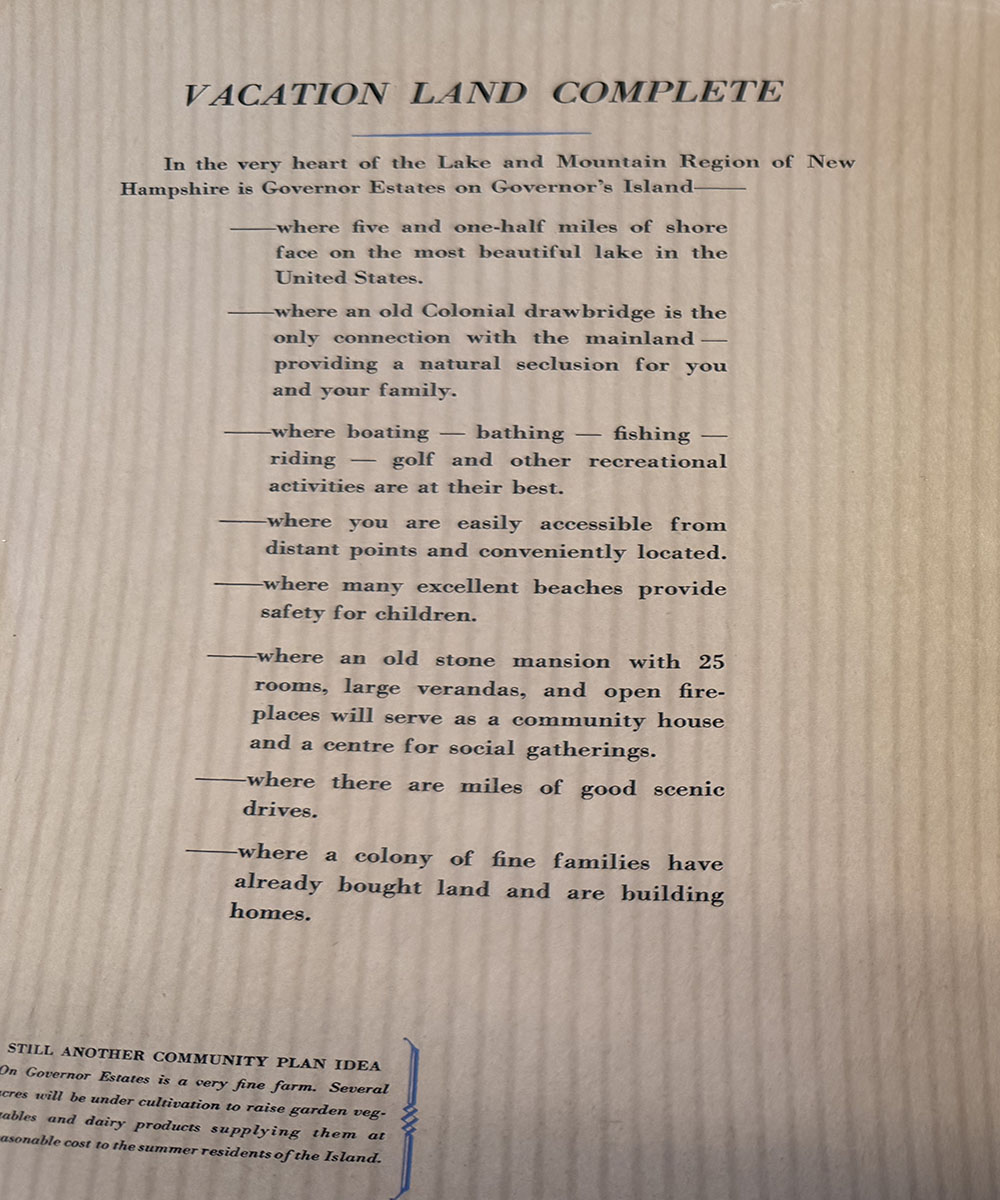
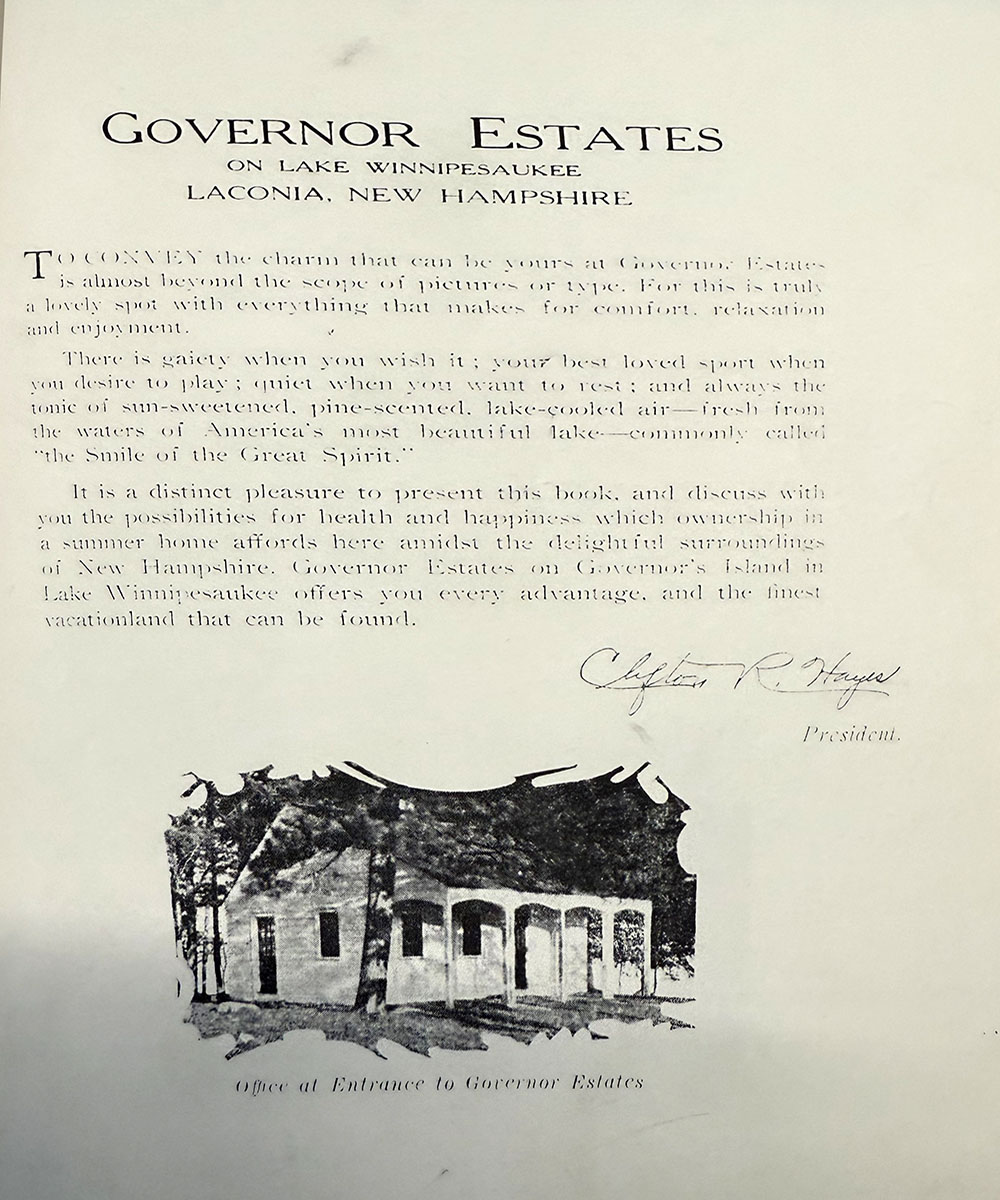
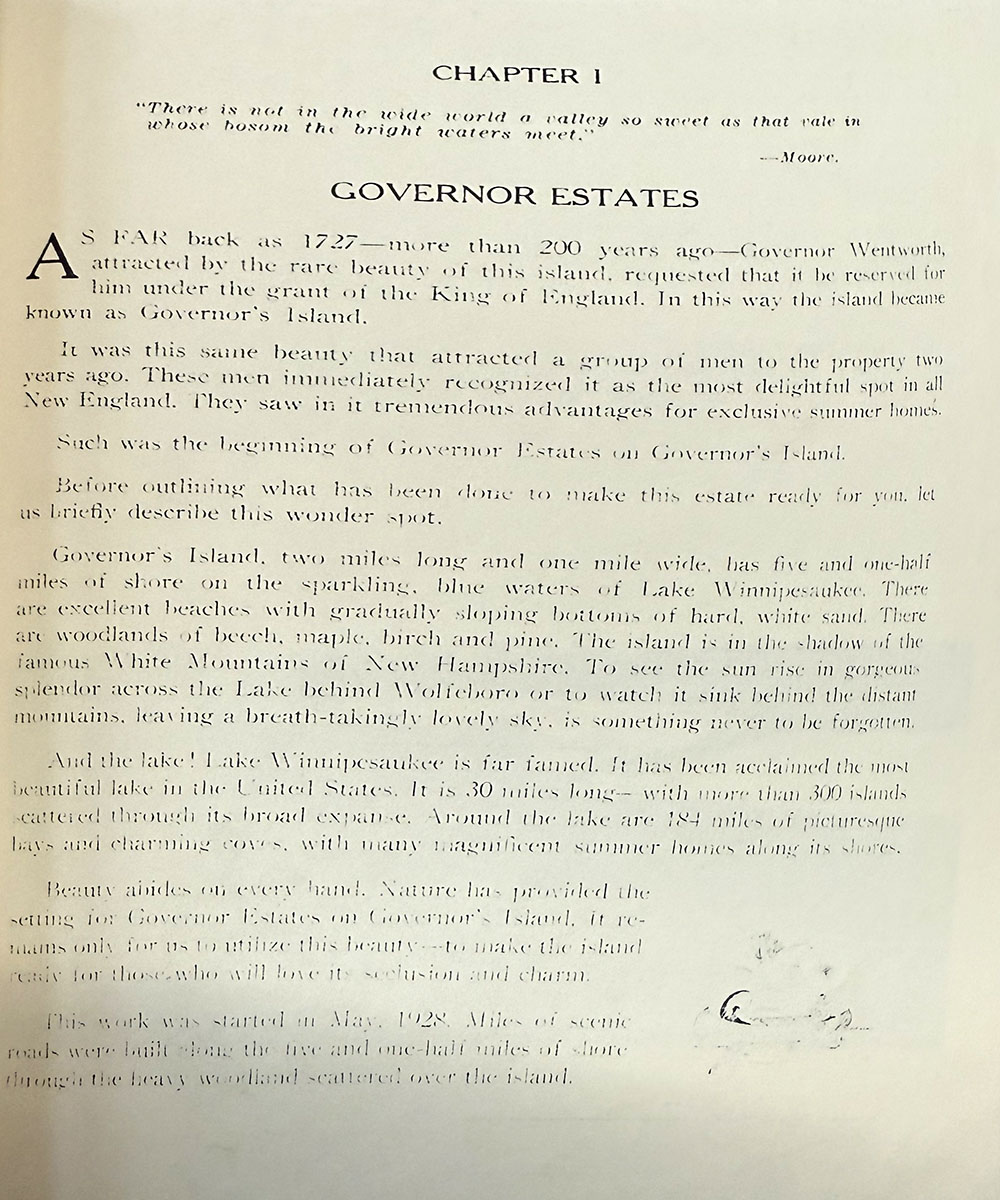
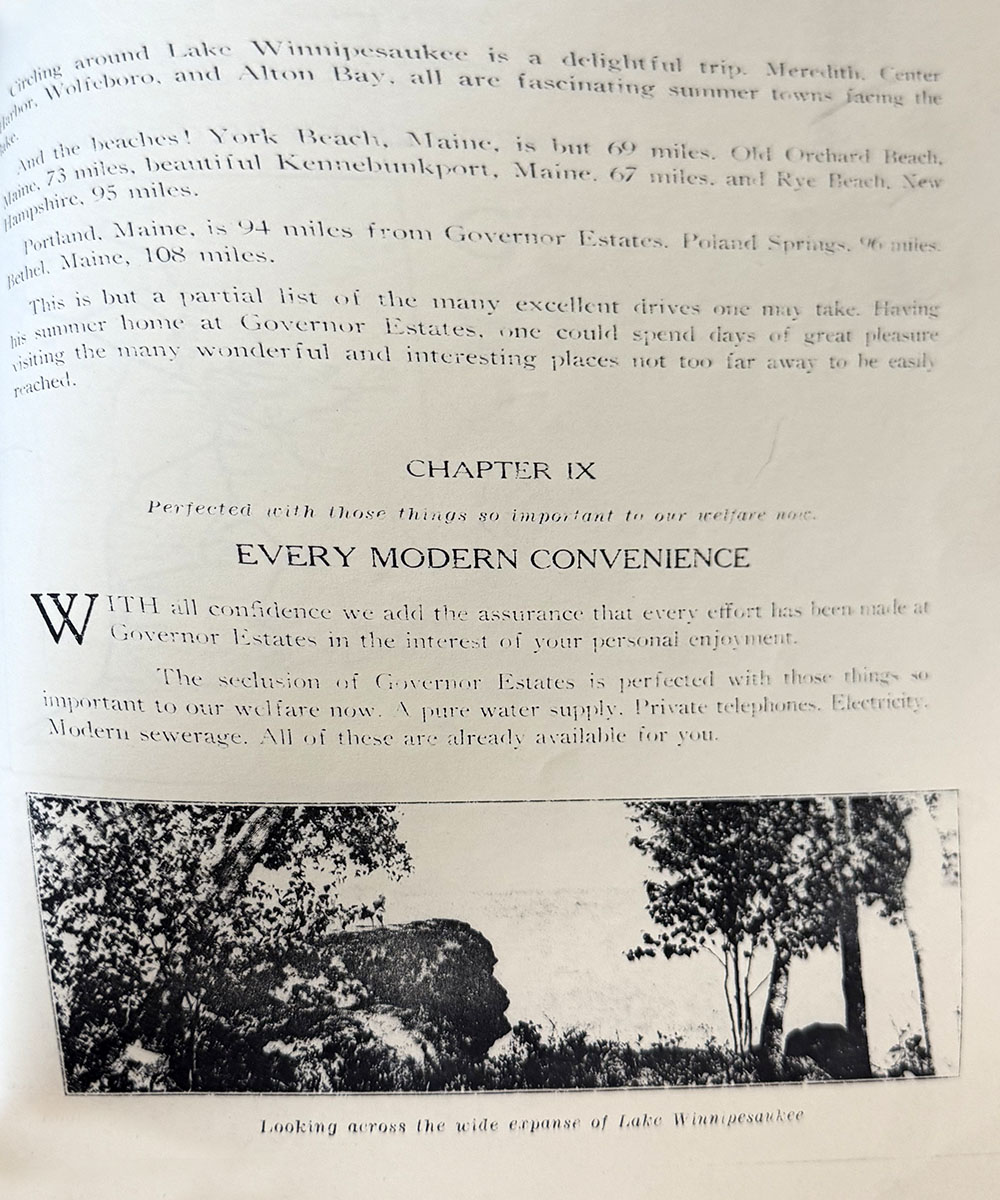
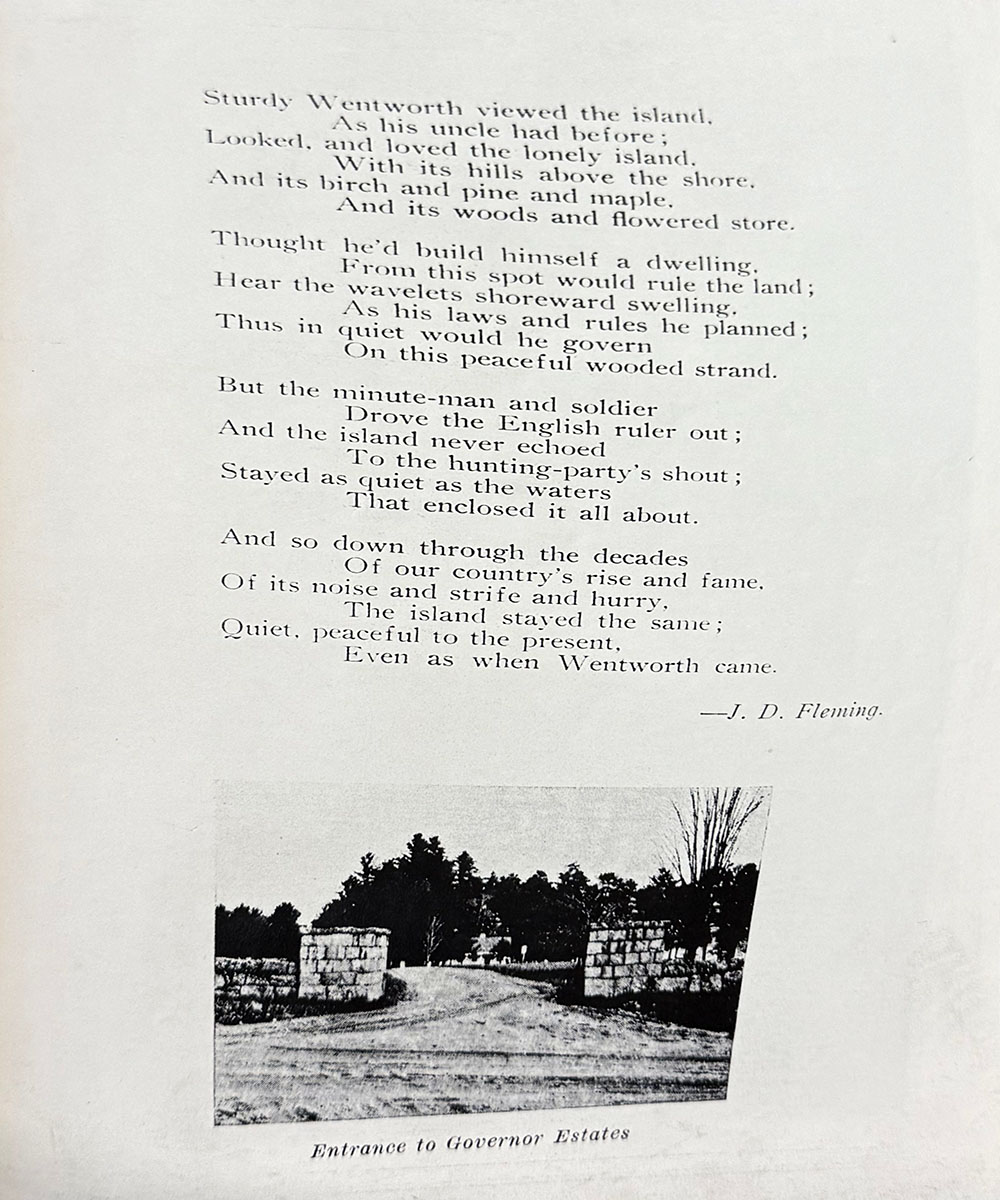
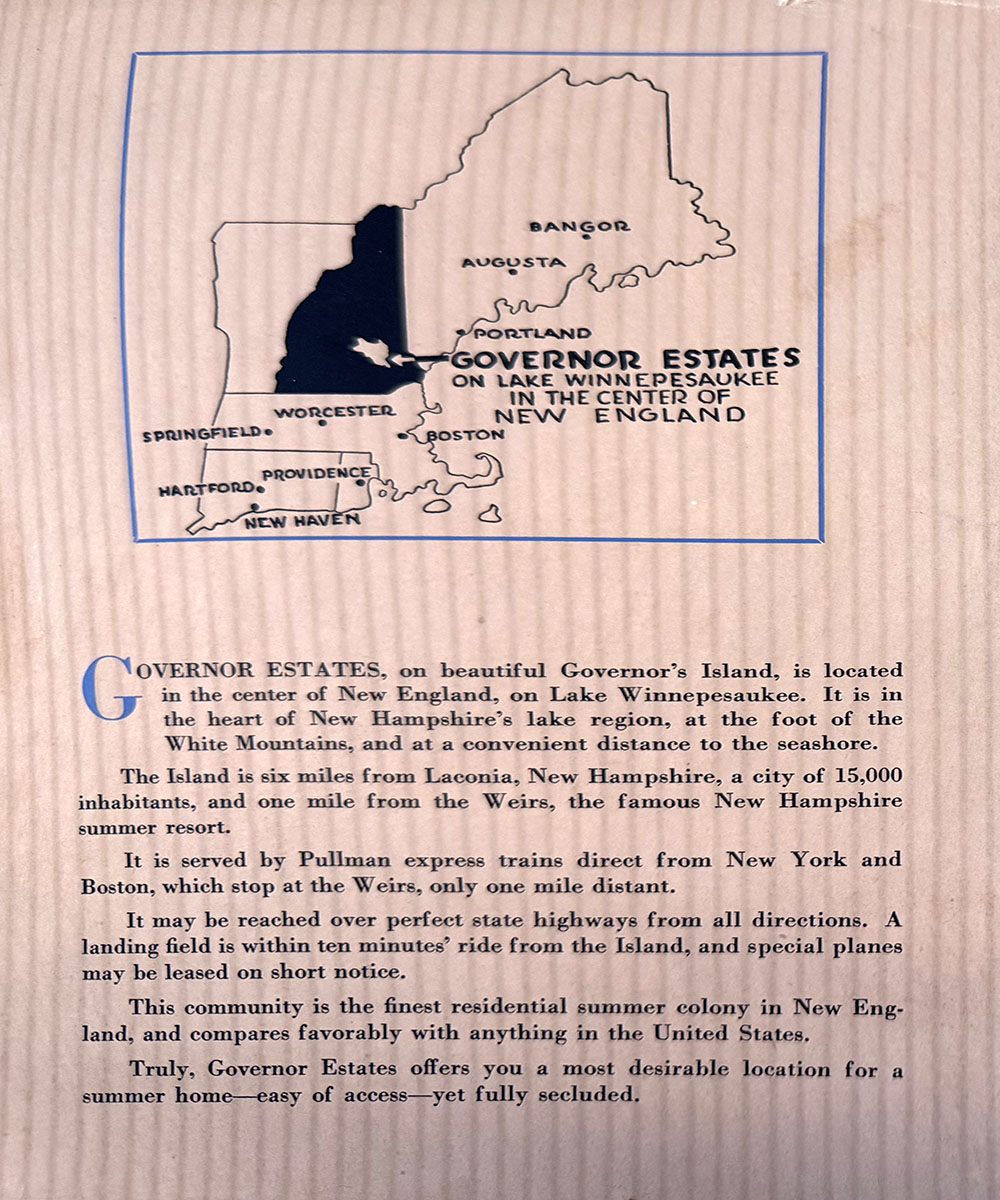
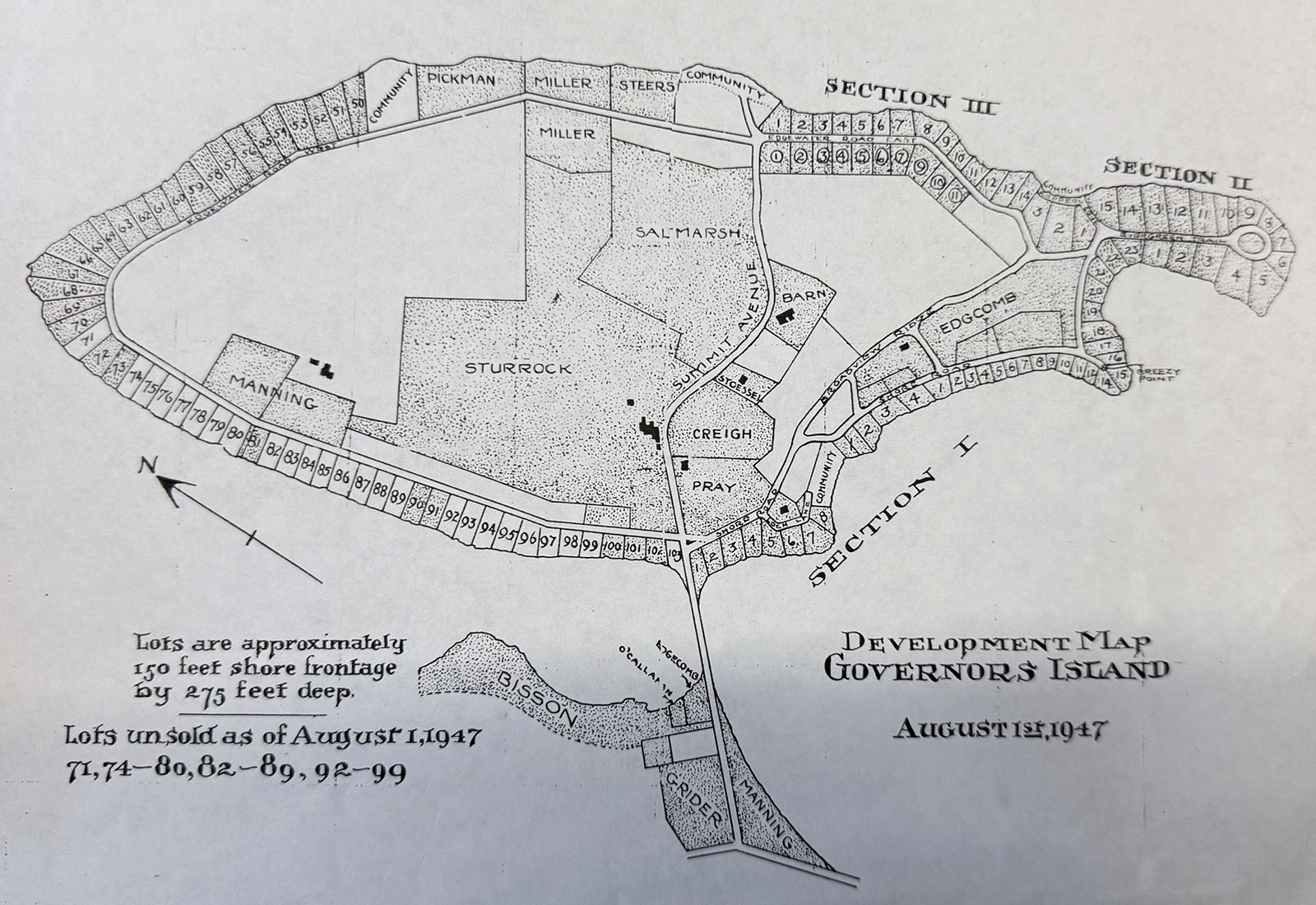
“Governor Estates” – Governor’s Island brochure, 1928. This marked the beginning of the island’s subdivision into building lots. The complete brochure is shown in black and white. Shown is a partial copy in color. The developer, Clifford Hayes, went bankrupt in 1935. Today, the island is run by its HOA (Homeowners Association), the Governor’s Island Club.
Governor Estates Booklet
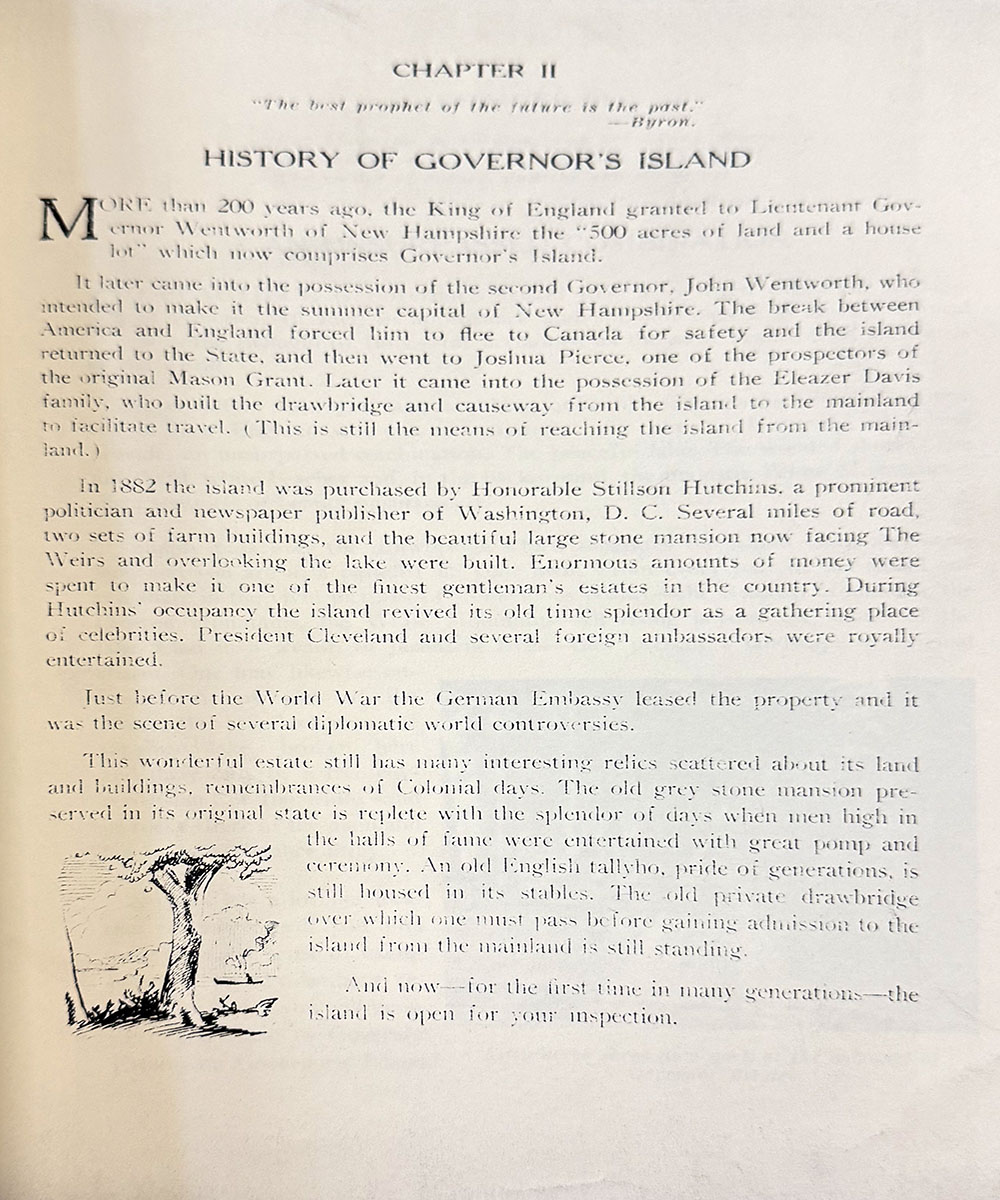
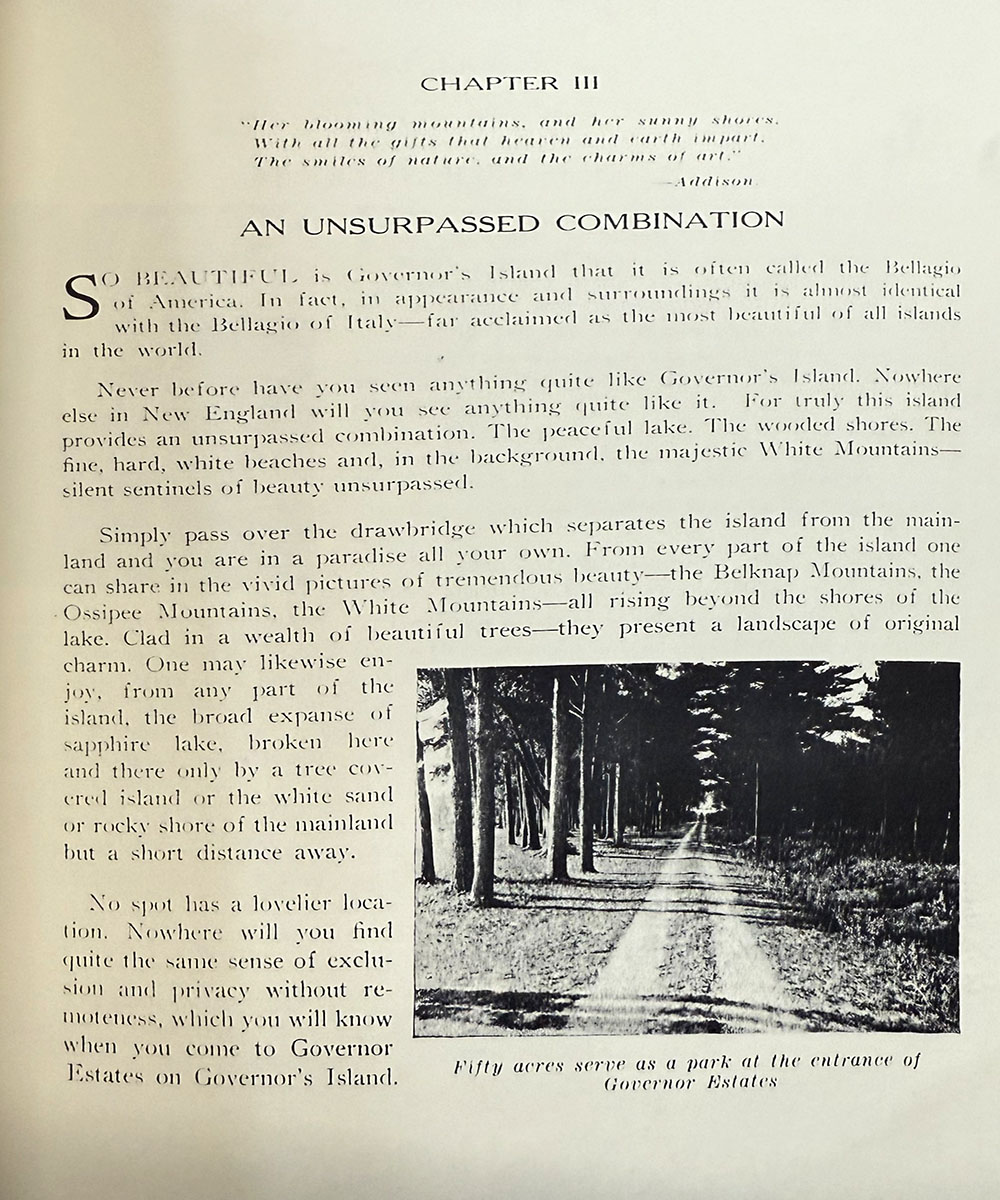
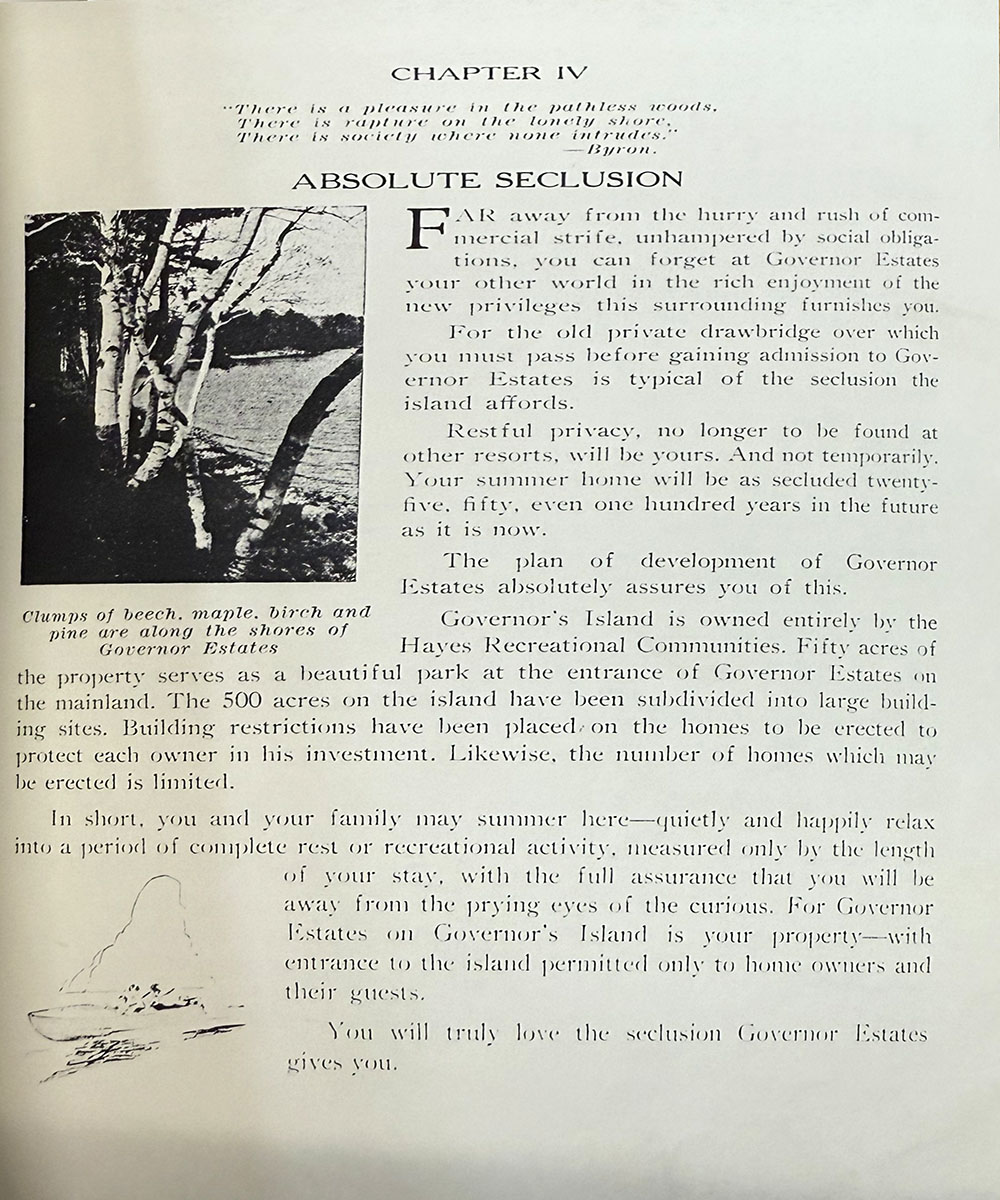
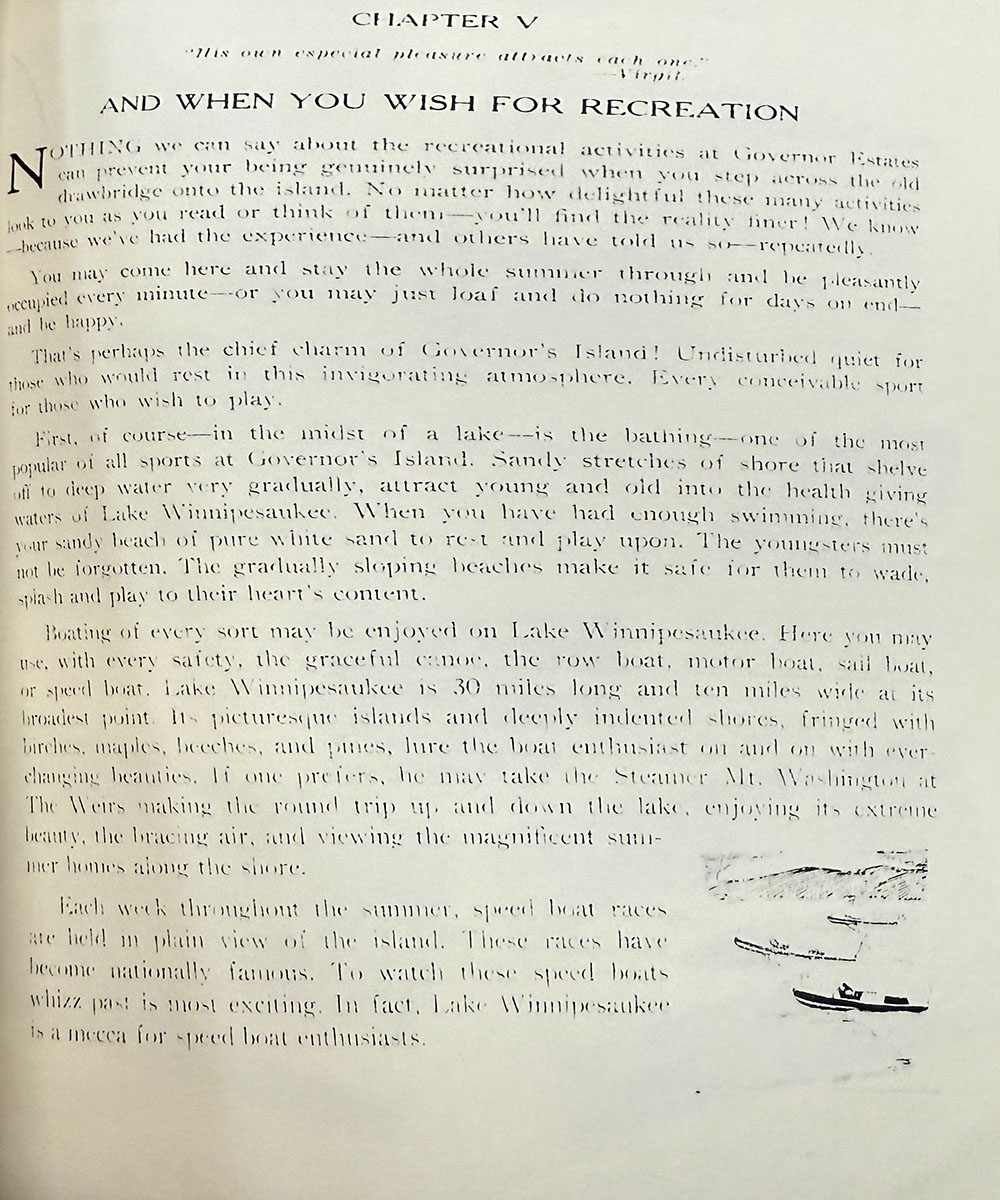
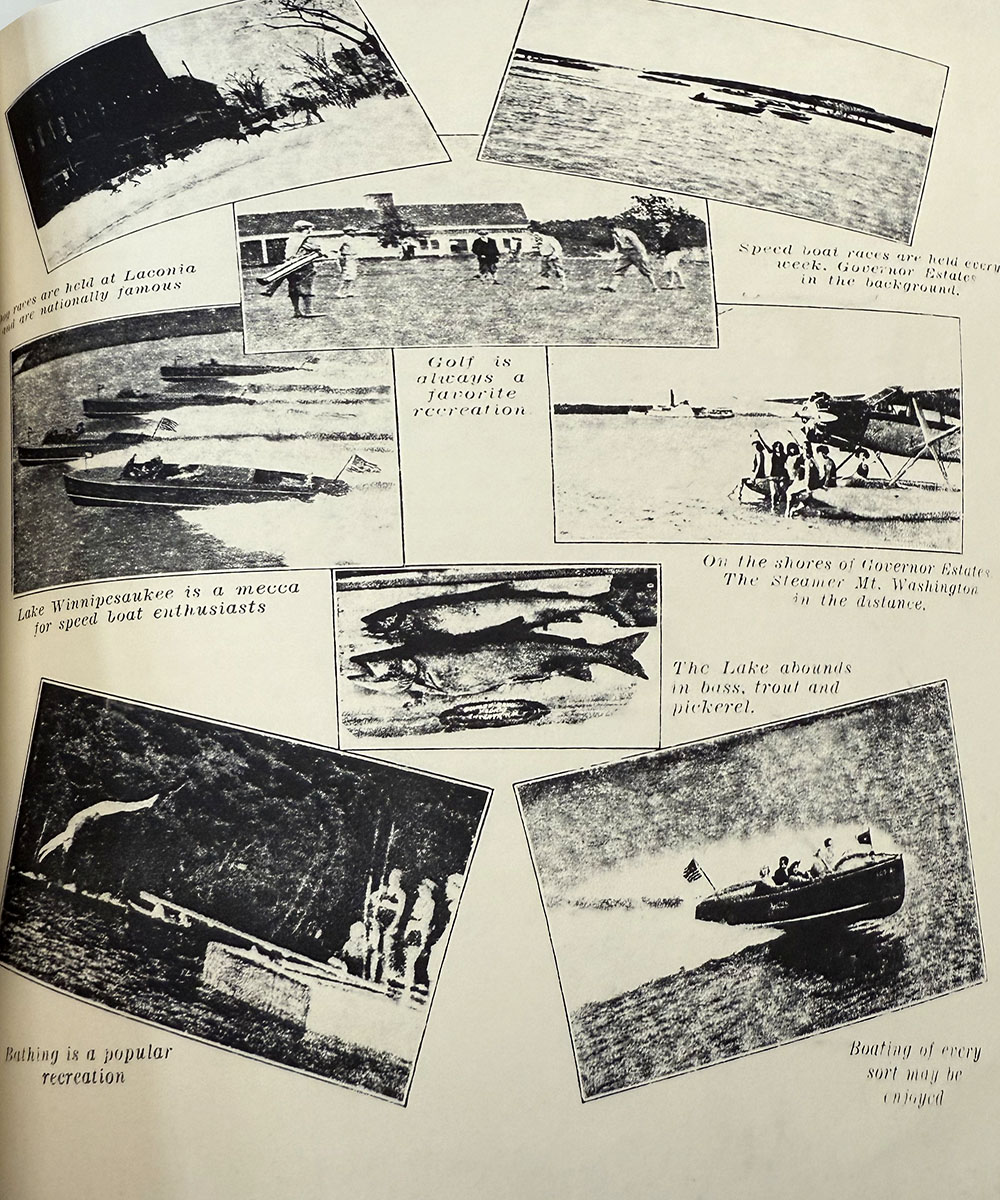
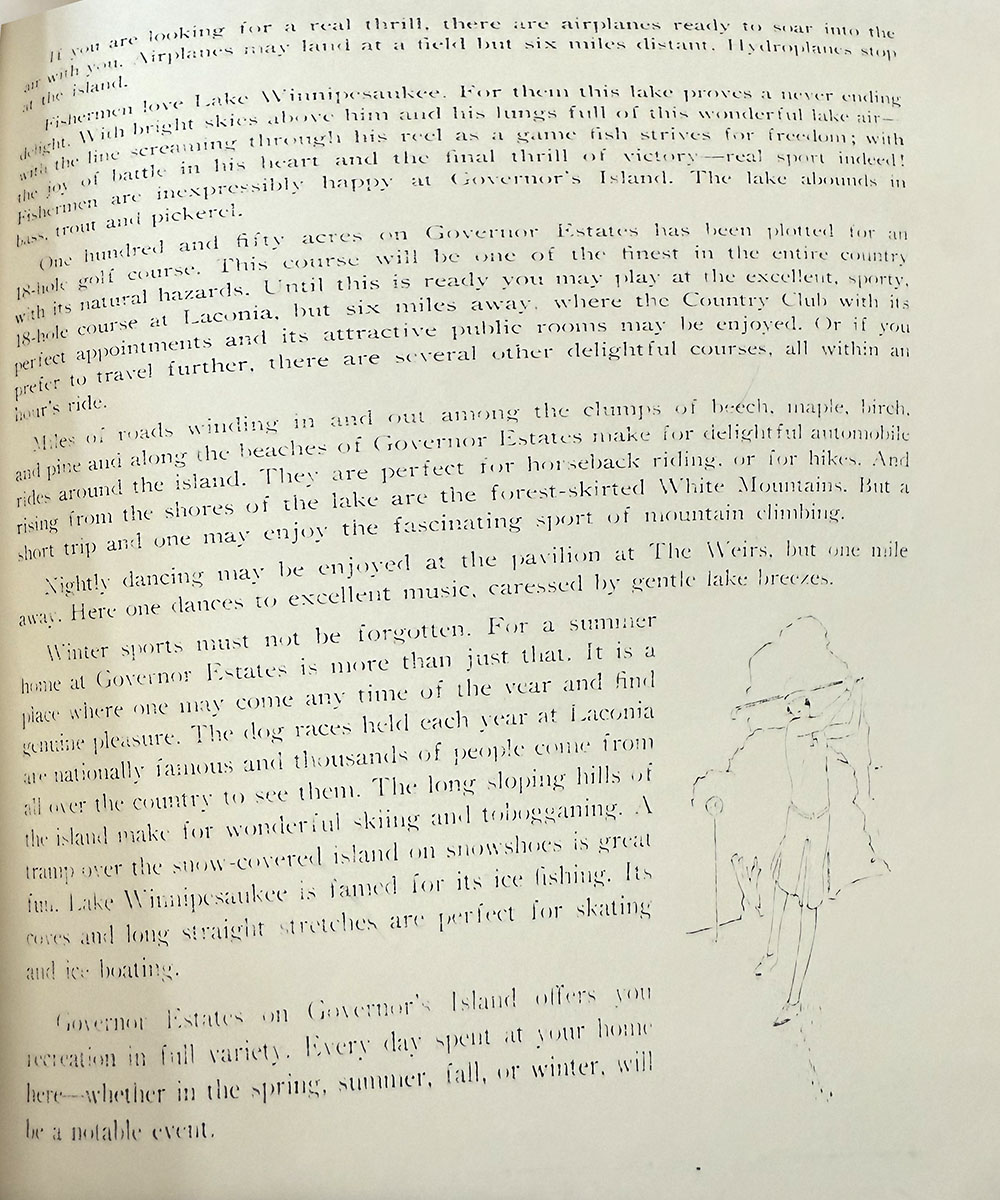
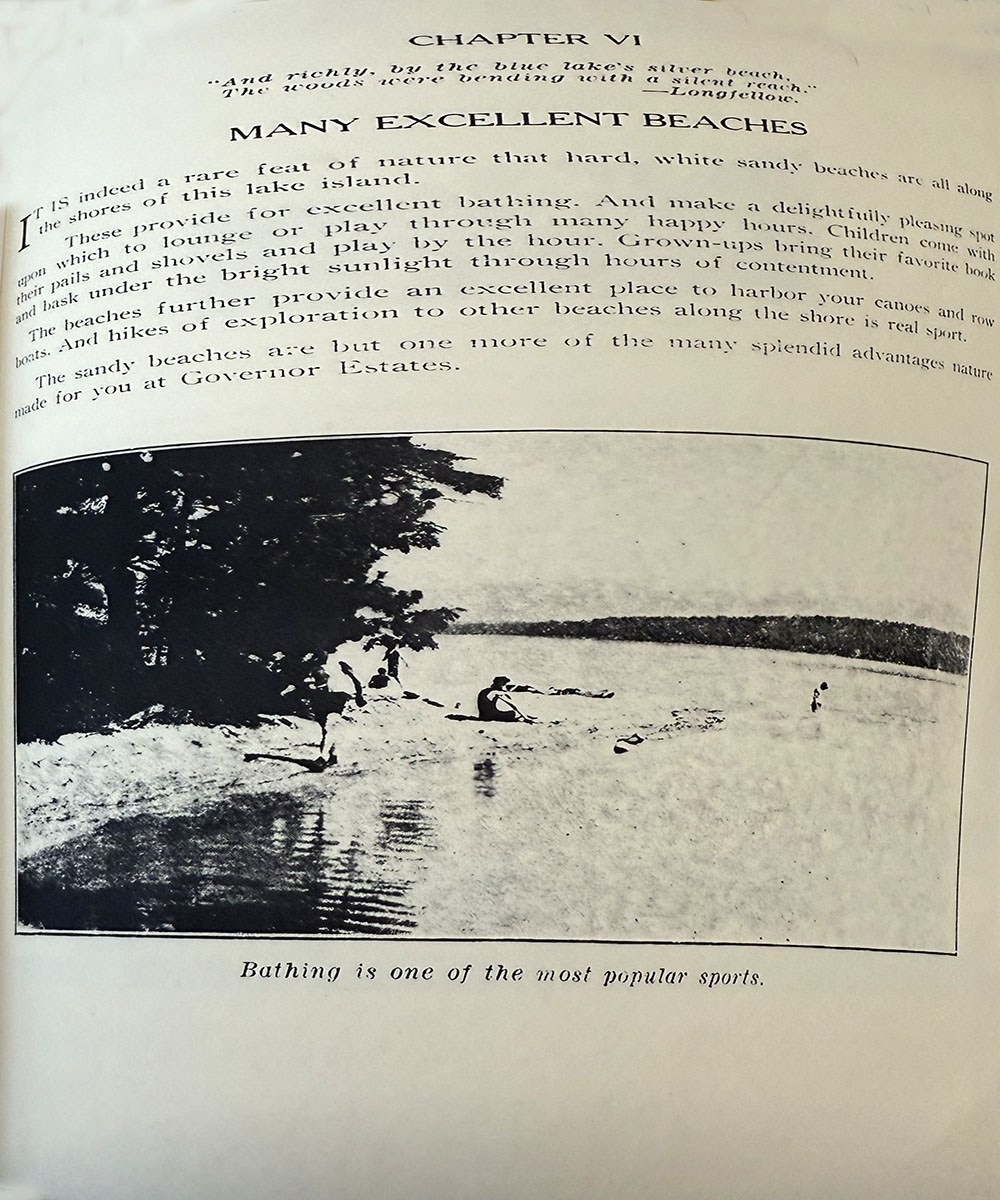
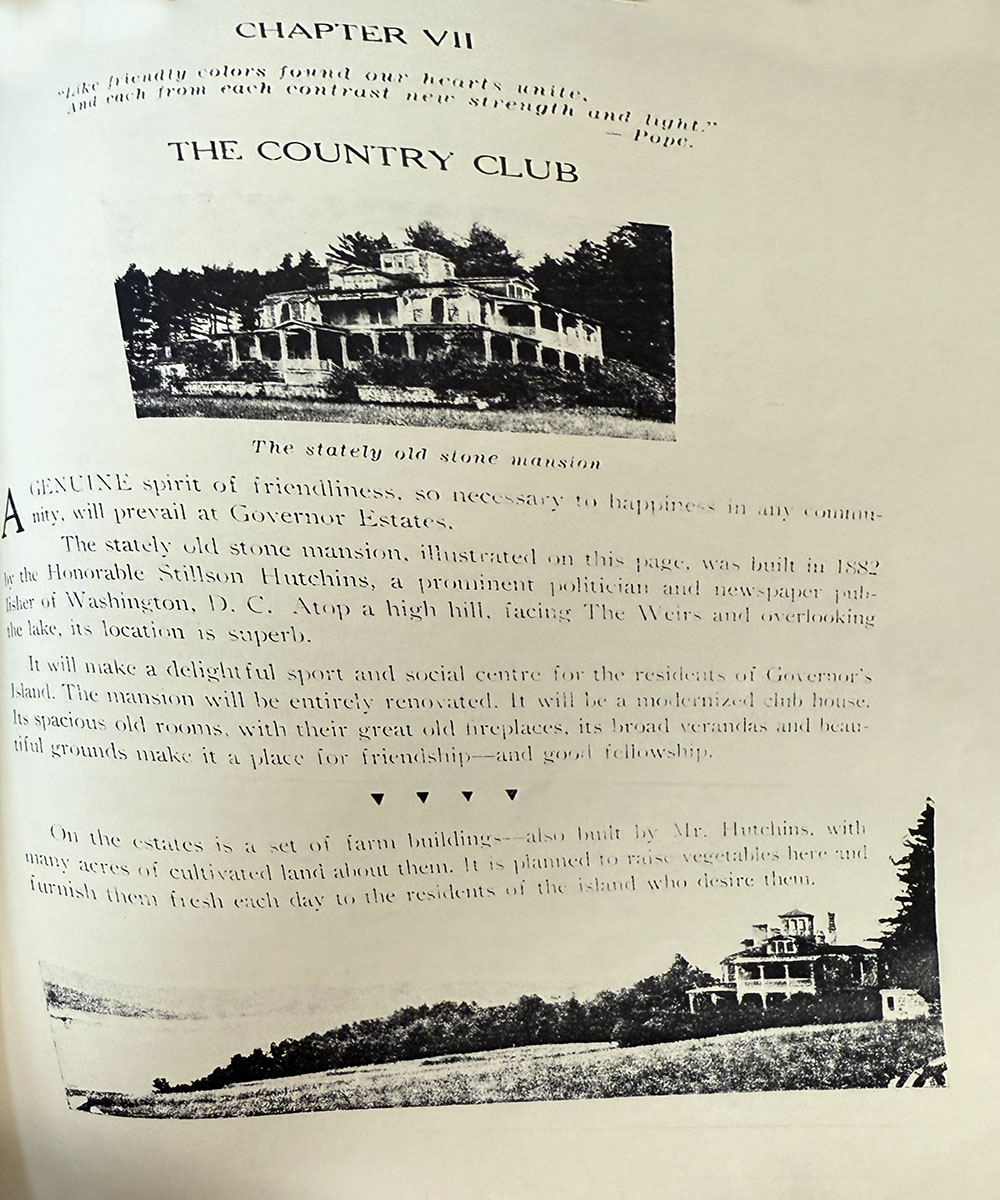
Development map of Governor’s Island, August 1st, 1947.
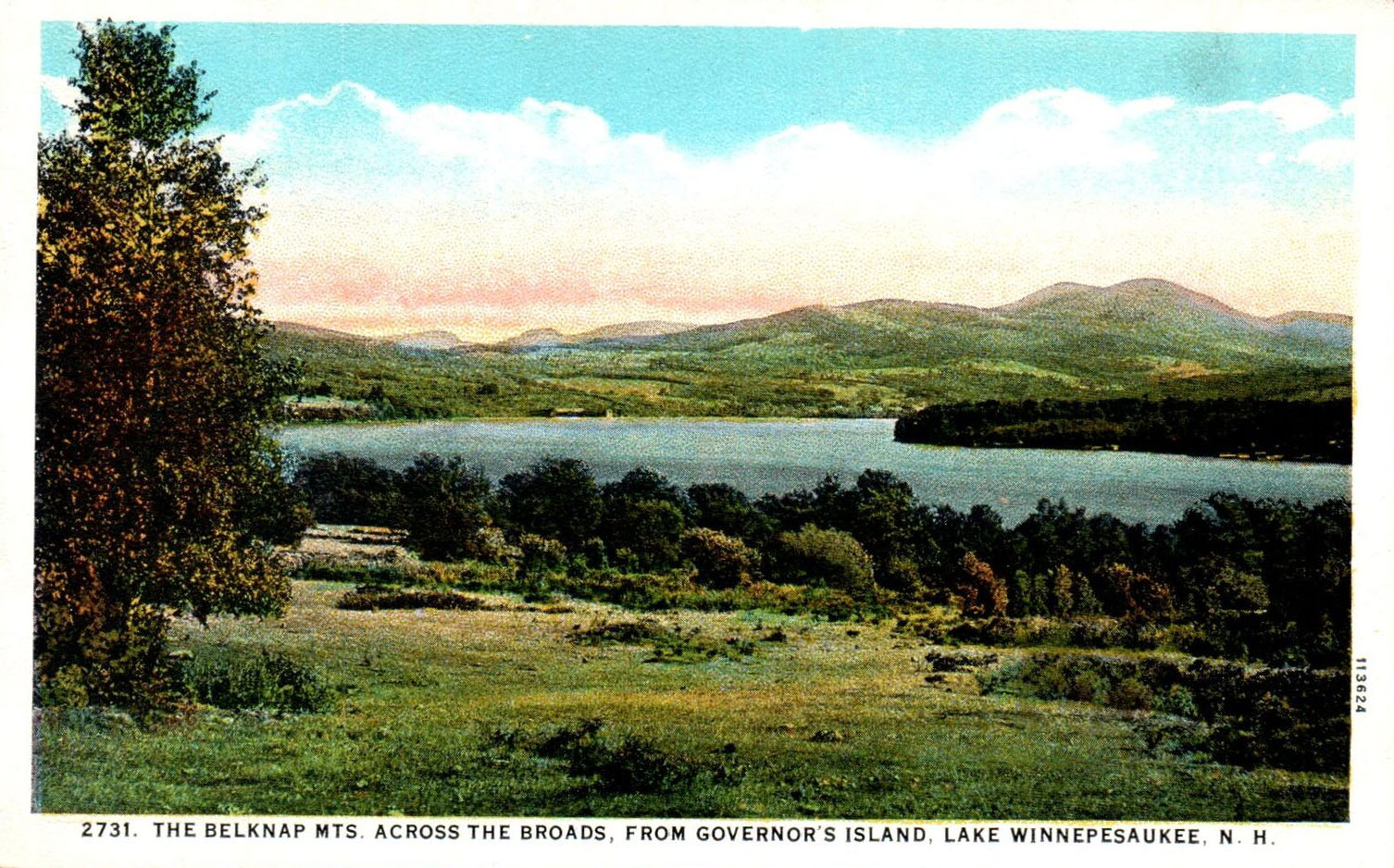
Views from Governor’s Island
A view of the Belknap Mountains from Governor’s Island around the same time as the brochure. There is almost no development seen in the view.
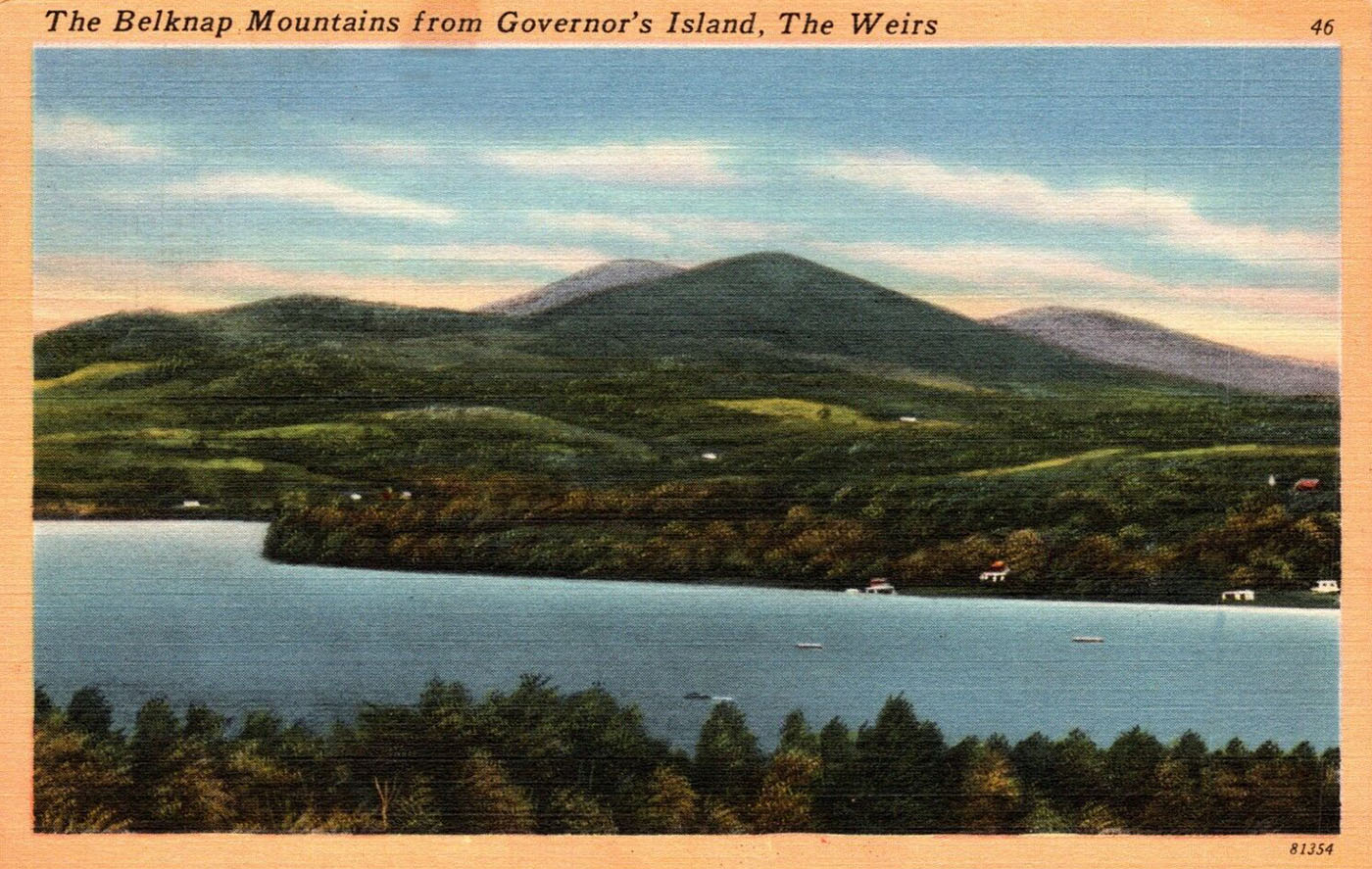
The Belknap Mountains from Governor’s Island, The Weirs
The Governor’s Island Club sign indicating the turnoff from Route 11B.